Four ways a mark gets onto a pot
Before reading what a mark says, notice how it was made. The method is often visible with the naked eye and it narrows things down.
Painted by hand
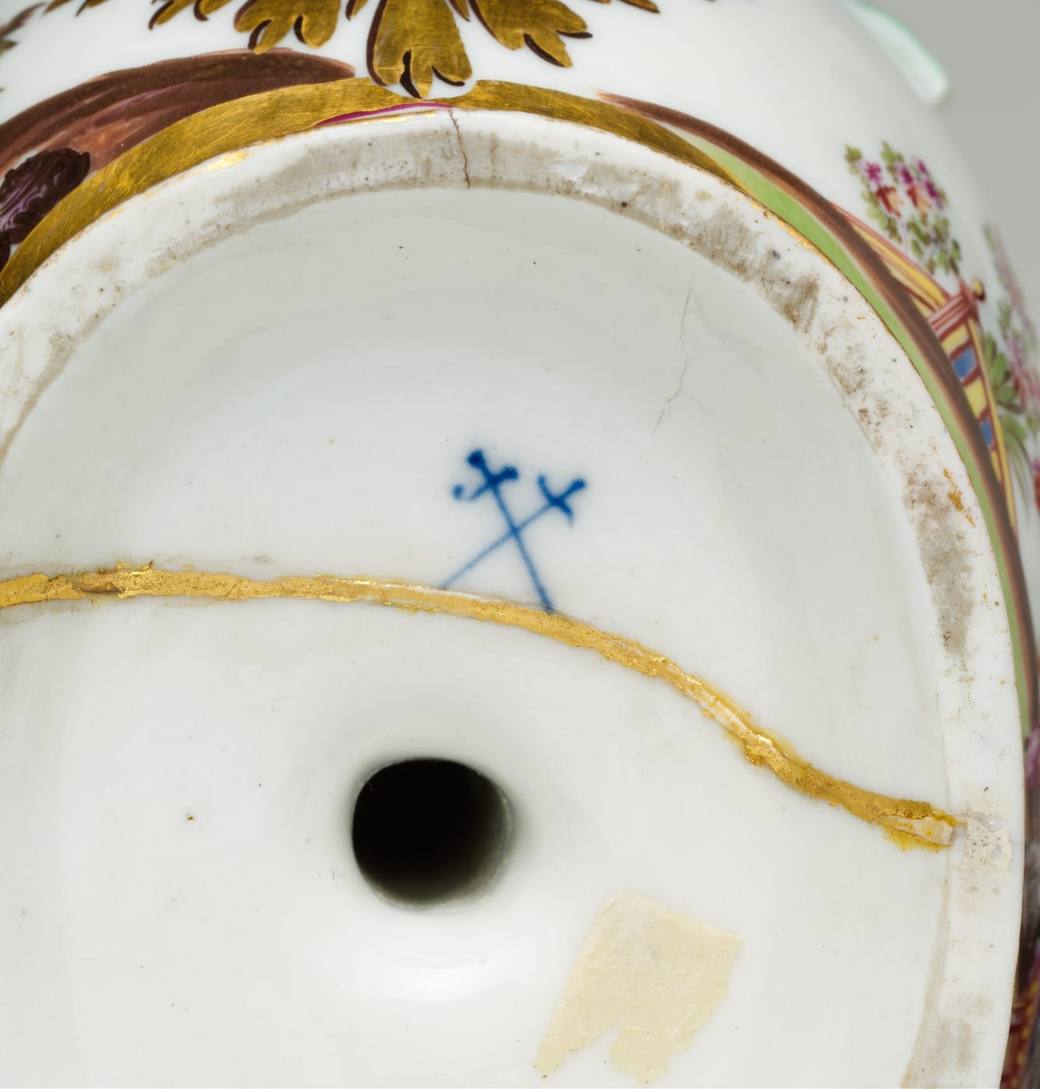
Meissen says its crossed swords have been applied by hand, in cobalt blue under the glaze, by specially trained painters.1 Painted marks vary from piece to piece because a person drew each one. Sèvres also painted its mark: two interlaced letters L. Chaffers, writing in 1912, says a single letter between them was the date letter, A for 1753, B for 1754 and so on, with double letters (AA, BB) beginning in 1778.4
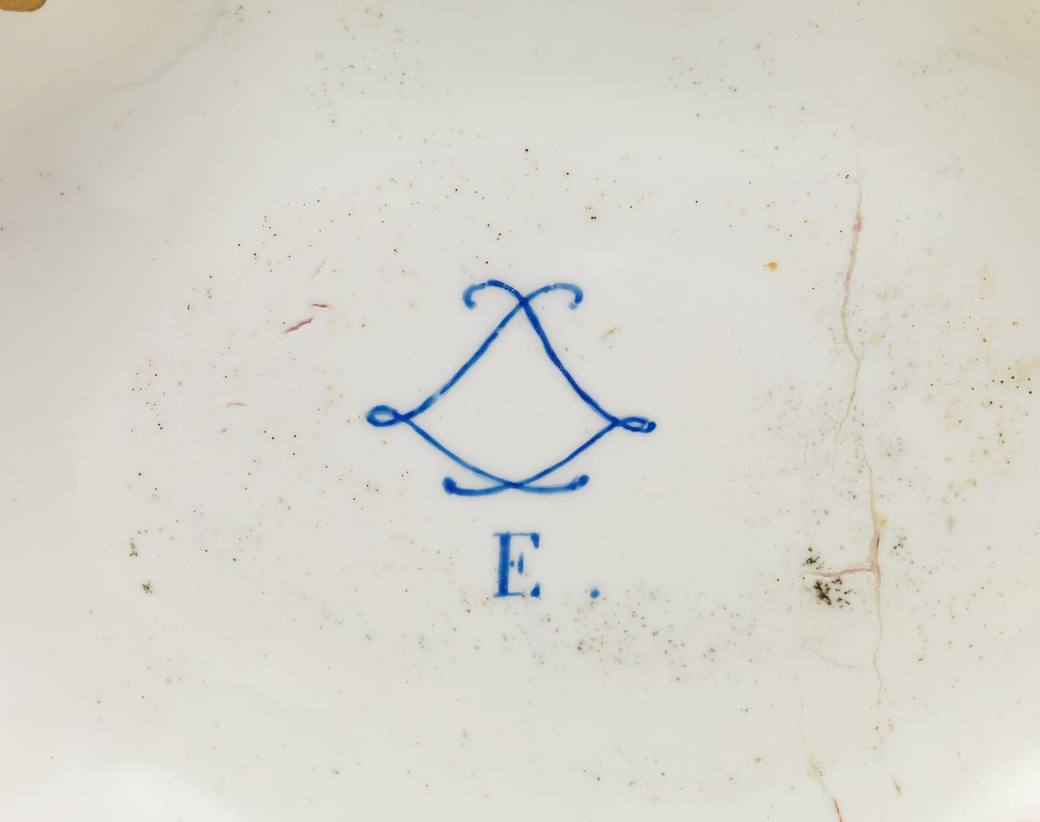
Date letters are read with care even by museums. The V&A notes that the Sèvres letter D is now read as 1757, not 1756 to 1757 as was formerly thought, after records were compared with surviving pieces.7 The Cleveland Museum of Art dates a pair of Sèvres tureens with the letter E, painted in blue, to 1757 to 1758.8
Printed
A printed mark is transferred onto the piece, so every copy looks alike. Belleek's printed mark shows an Irish wolfhound, a round tower, a harp and a banner reading Belleek, and the company dates each version of it: the first from 1863 to 1891, the second from 1891 to 1926, and so on through a gold mark of 1980 to 1993.10 The Museum of Royal Worcester says the 51 in the centre of the printed Royal Worcester mark stands for the founding year, 1751, not the year the piece was made.11
Impressed into the clay
An impressed mark is pressed into the soft clay with a stamp before firing, so it sits below the surface. Burton and Hobson say Wedgwood marks are nearly all stamped.3 Chaffers says that after Bentley's time the word WEDGWOOD was stamped in capitals or small letters of varying sizes, sometimes a large stamp on a small piece and the reverse.4
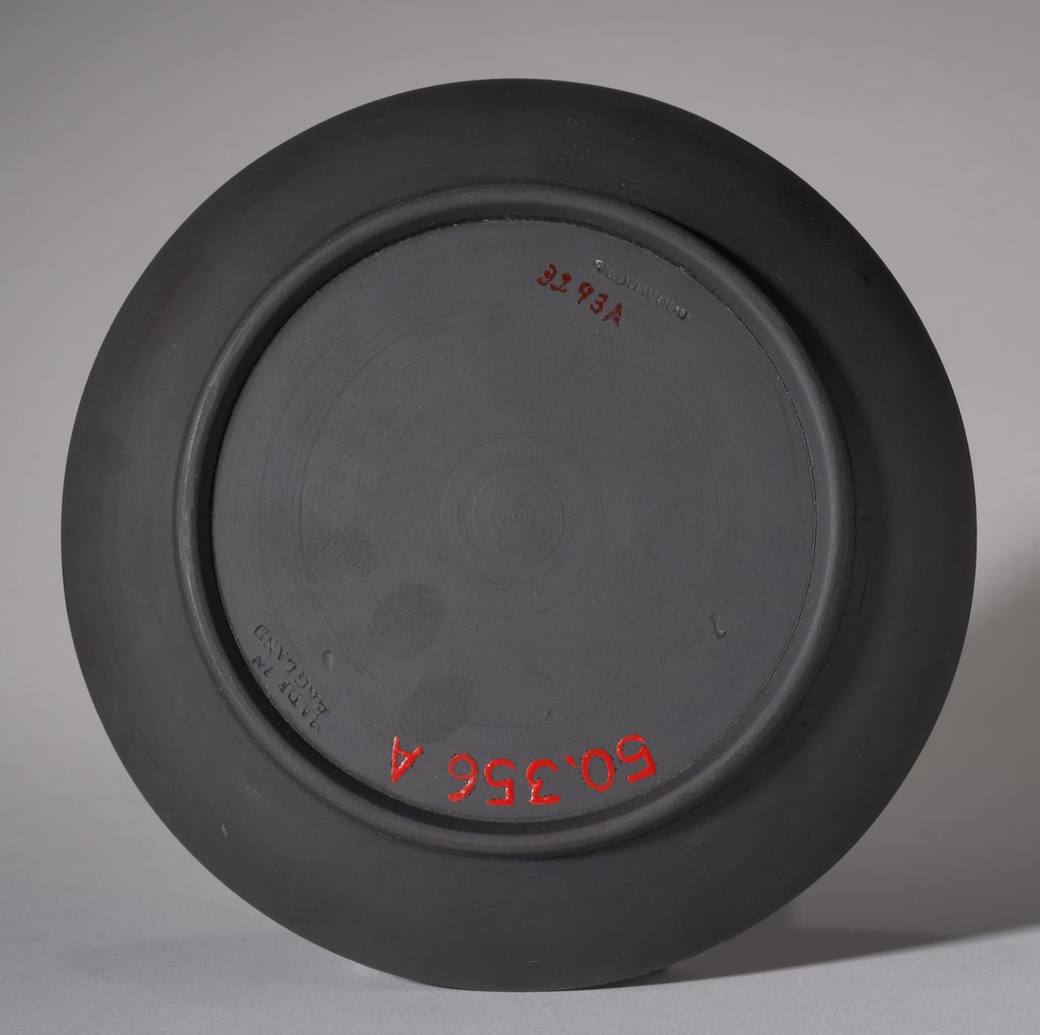
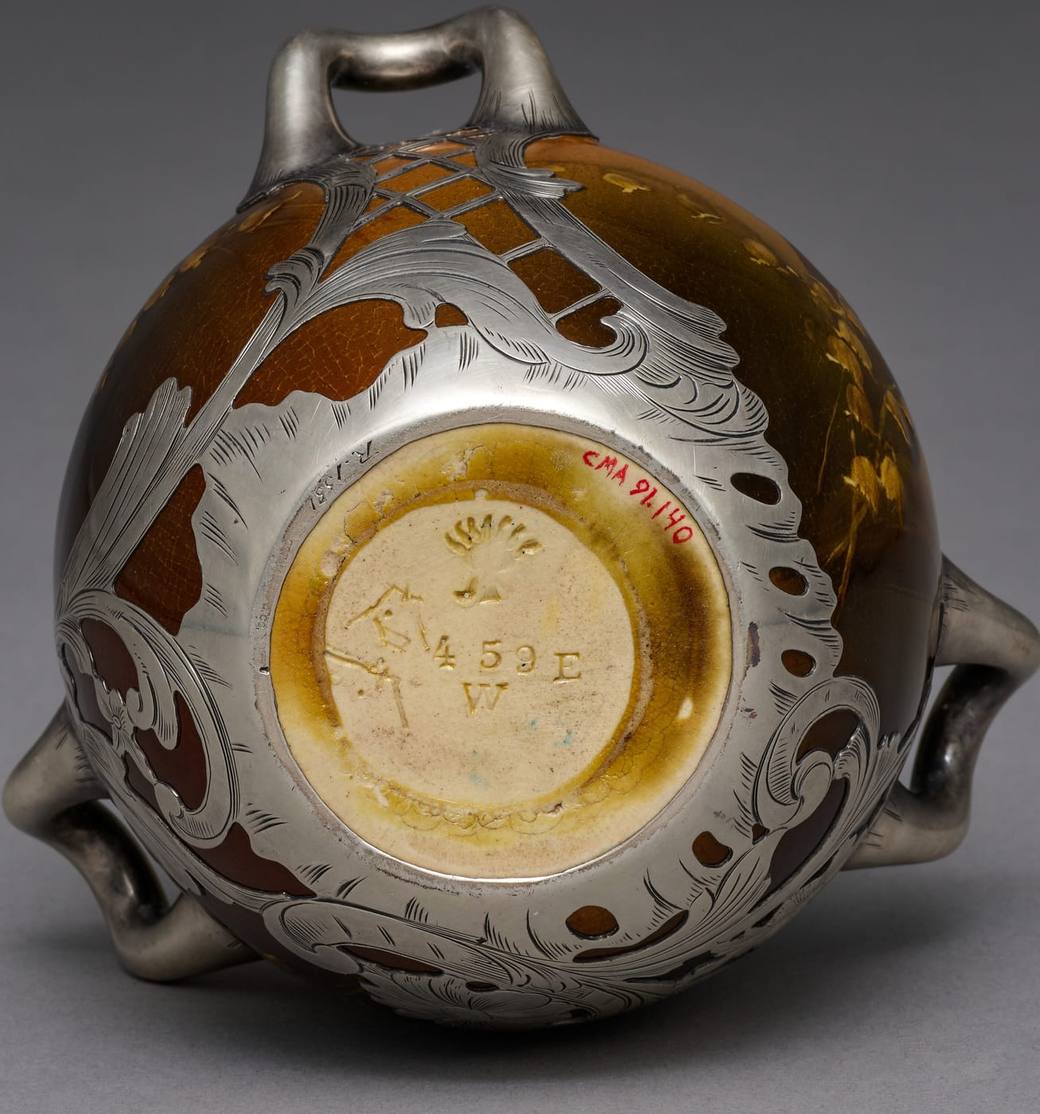
Rookwood used impressed marks as a calendar. Barber's book of 1904 says the RP monogram had one flame point added above it in 1887 and one more each year, so the mark for 1900 has fourteen points, and that from 1901 a Roman numeral was added below.13 The same book lists single letters beside the main mark for the colour of the clay (G, O, R, S, W or Y) and for the size of the vase (A to F).13 The museum record for the vase above also notes a second firm's stamp, "Gorham MKG. CO.", on the rim of the silver overlay, so one object can carry two makers' marks.26
Scratched or incised
Some marks were cut into the clay by hand. Chaffers says the letter B, for Martin Barr, is found indented on Worcester pieces between 1793 and 1803, and that Derby's earliest work carries a plain D or the word Derby, usually roughly scratched in the paste.4
Stated range or dated example
Mark books and maker records hold two different kinds of evidence, and it helps to know which one you are looking at.
- A stated range is a source saying a mark was used from one year to another. Belleek's own dates for each version of its mark are stated ranges.10
- A dated example is a single museum piece, dated by the museum, that carries the mark. The V&A records two crossed swords painted in blue on a Meissen figure it dates to about 1760 to 1762.5 That shows the mark was in use then. It says nothing about when the mark started or stopped.
The difference matters. Chaffers says the linked letters A R were Meissen's first mark, in use from about 1710 to 1712.4 Yet the V&A records an A R monogram painted in blue on a vase it dates to about 1734.6 Chaffers also says a Dresden firm, Wolfsohn, used an A R monogram on porcelain not made at the state factory.4 A single book range would have misled you in both directions.
Dated examples can also settle a disagreement. Barber says Rookwood's first flame point was added in 1887; the Miami University museum says one flame was added each year after 1888.13,14 A museum record of a Rookwood vase dated 1888 shows two flame points, which fits Barber's start.15
Sometimes the sources simply differ, and the honest answer is a range of opinions. For the start of the Meissen swords, Meissen gives 1722, Burton and Hobson give 1725 onwards, and the German Patent and Trade Mark Office says the swords were generally established from 1731.1,3,2
What a mark can tell you
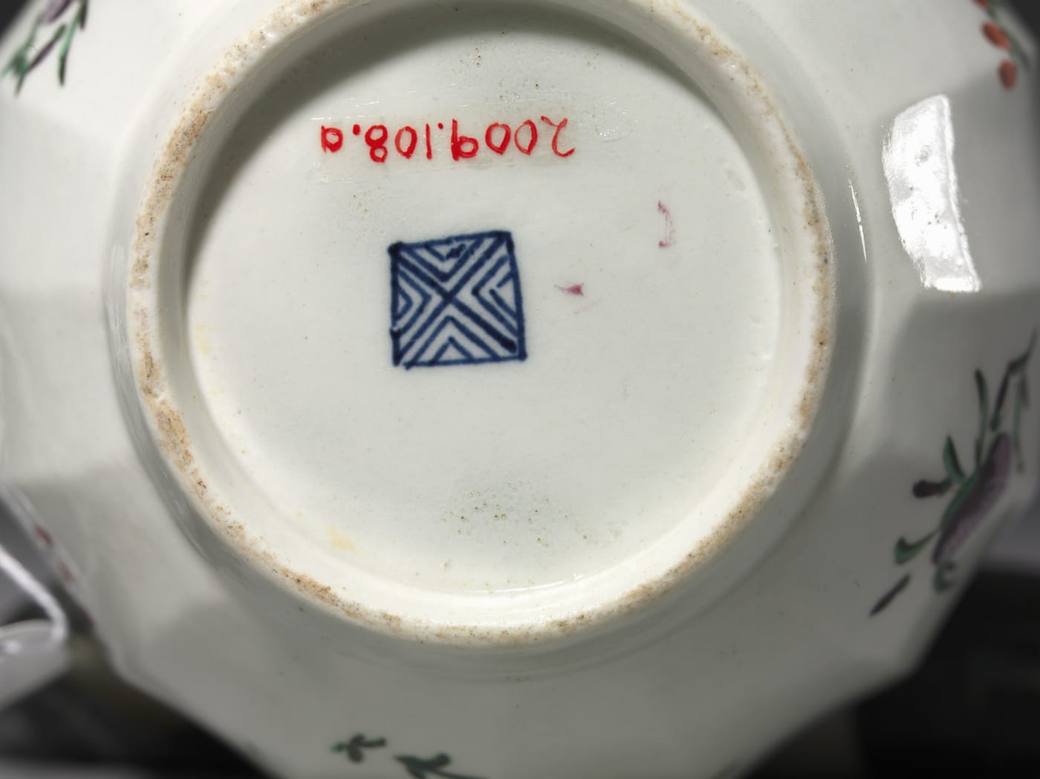
At its best, a mark names the maker and narrows the date. Some factories added year codes. The Museum of Royal Worcester says the printed Worcester mark almost always includes one: from 1867 a single letter below the mark, starting with A for 1867 and running through the capitals (the list skips F, J and Q, and O stands for 1889, after Z for 1888) to a small a for 1890, and from 1892 a dot added each year.11 Royal Crown Derby says its mark carries a date mark that identifies the year of manufacture.17
What a mark cannot tell you
A year code is not always the year of making. The Museum of Royal Worcester says that from the mid 1960s the date on its bone china tableware stamp is the year the design was introduced.11 Rosenthal itself says a stamp gives only rough dating, because many designs were made unchanged for decades.16
Nor does a mark always come from the factory it names. The V&A records crossed swords and a figure 9 in blue on Worcester porcelain of about 1760, copying the Meissen mark,12 and Chaffers says Worcester copied the marks of most of the celebrated factories in turn.4 The V&A says a Paris firm, Samson, copied Crown Derby figures with a copied mark.18 Limoges is a town with many porcelain factories, so a Limoges mark on its own does not mean Haviland.19 The V&A even describes a K on one Sèvres saucer as probably a nineteenth century addition.9
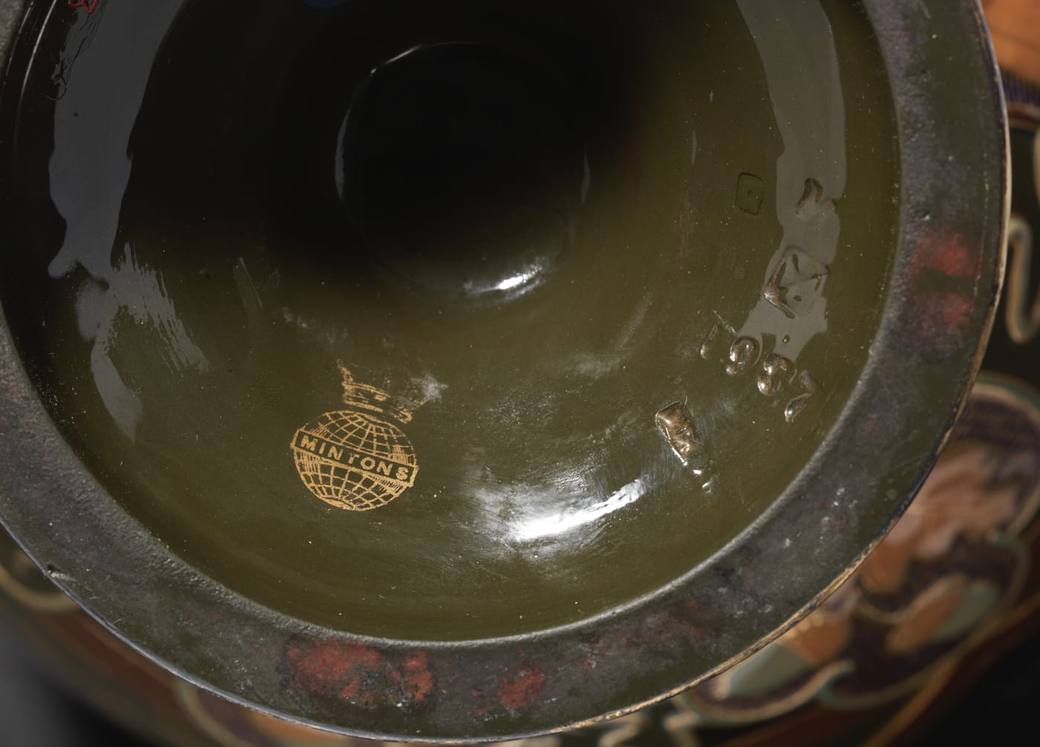
And an unmarked piece is not ruled out. Chaffers says excellent Worcester is frequently unmarked and that pieces of one service are sometimes found with different marks.4 Minton's year marks show the limit of museum readings too: the V&A reads impressed symbols as year marks on pieces it has already dated.20
So treat a mark as strong evidence for a maker and a period, to be read alongside the shape, the body and the decoration.
Maker pages
Each of these pages lists the marks recorded for one maker, with the dates each source gives and the museum examples behind them:
- Belleek marks
- Clarice Cliff marks
- Haviland marks
- Lenox marks
- Meissen marks
- Minton marks
- Moorcroft marks
- Rookwood marks
- Rosenthal marks
- Royal Crown Derby marks
- Royal Doulton marks
- Royal Worcester marks
- Sèvres marks
- Spode and Copeland marks
- Susie Cooper marks
- Wedgwood marks
- Weller marks
Sources
Every fact above is taken from these sources. The small numbers in the text point to them.
- 300 Years Swords Anniversary (Meissen history page)
- The crossed swords (Traditional East brands)
- Handbook of Marks on Pottery and Porcelain (Burton and Hobson)
- Marks and Monograms on European and Oriental Pottery and Porcelain (W. Chaffers, 1912 edition)
- Figure of a kneeling nymph, Meissen, ca. 1760-62 (museum no. O1300375)
- Vase and cover, Meissen, ca. 1734 (museum no. O332838)
- Mustard pot (moutardier), Sèvres, 1757 (museum no. O98950)
- Pair of Covered Tureens on Stand (Paire de pots-à-oille), 1757–58 (accession 1953.25)
- Saucer, Sèvres, 1777 (museum no. O100402)
- Date Your Belleek: Official Marks and Certification
- Royal Worcester factory marks
- Cup and saucer, Worcester, ca. 1760 (museum no. O336862)
- Marks of American Potters (Rookwood entry pp. 118-121)
- The Rookwood Pottery Collection: Introduction
- Art Institute of Chicago public API, artwork 41487 (Vase, 1888), inscriptions field
- Determining the age and value of Rosenthal porcelain (Tips for collectors)
- Historic Backstamps (Royal Crown Derby)
- Figurine of Othello, Samson copy of a Crown Derby figure, late 19th century (museum no. O121334)
- Limoges porcelain in its prime
- Comport, Minton, 1885 (museum no. O77917)
- Wine pot in the shape of a peach (cadogan type), Meissen Manufactory, ca. 1725 (accession 1974.356.488)
- Potpourri vase (pot-pourri à vaisseau), Sèvres Manufactory, 1758 (accession 58.75.89a, b)
- Teapot, Worcester Porcelain Factory (British, established 1751), c. 1755–75 (accession 2009.108)
- Saucer, Wedgwood Factory (British), 1800s (accession 1950.356.b)
- Olive-green ground vase with pâte-sur-pâte decoration, Minton(s), 1884 (accession 2019.597.3)
- Vase, Rookwood Pottery Company (American, established 1880), 1893 (accession 1991.140)
Last checked: 22 November 2026. Compiled with the help of AI from the sources on this page and checked against them. Published by The Apptor. How this is made.