Rookwood Pottery marks
11 entries from 6 sources. 8 give a period of use stated by a source. The other 3 are marks seen on pieces of known date, which shows only that the mark was in use then.
Go to the marks

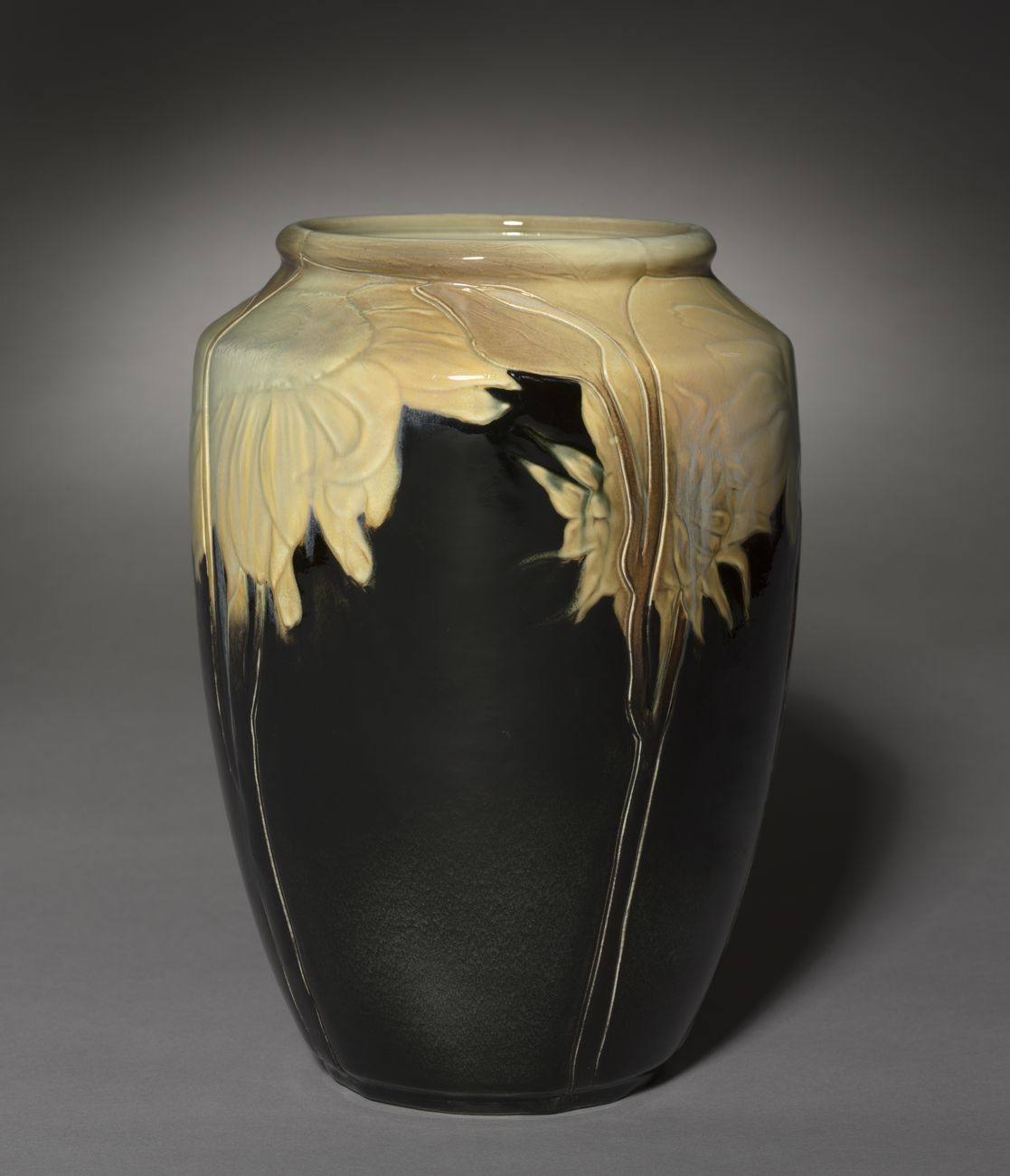
- Where Cincinnati, United States
- Founded 1880
- Made Art pottery
- Status Still trading
Founded 1880: (Source: the Richard and Carole Cocks Art Museum, Miami University). Status: still trading. (Source: the Richard and Carole Cocks Art Museum, Miami University)
What the sources say
Rookwood was started in Cincinnati in 1880 by Maria Longworth Nichols, and the Rookwood Pottery Company was formally formed in 1890. (Sources: the Richard and Carole Cocks Art Museum, Miami University and the Kent State University Museum)
In 1904 Barber described it as having more marks than any other American pottery, in five kinds: factory marks, clay marks, size marks, process marks and decorators' marks. (Source: Edwin Atlee Barber (1904))
From 1886 the factory mark was a reversed R joined to a P; Barber says a flame point was added above it in 1887 and one more each year, giving fourteen points in 1900, and a Roman numeral for the year from 1901. (Sources: Edwin Atlee Barber (1904) and the Richard and Carole Cocks Art Museum, Miami University)
The company went bankrupt in 1941, changed hands in 1942, and was revived in 2006, so the period after the 1930s needs separate treatment from the marks recorded here. (Source: the Richard and Carole Cocks Art Museum, Miami University)
The marks
11 Rookwood Pottery entries
Each entry describes a mark in plain words, with how it was put on and the evidence for its date, in the words of its source.
-
Period stated by the source
Years: until 1882
The word ROOKWOOD, or the initials R.P.C.O. (with M.L.N. for the founder), together with a date, painted or cut into the base by the decorator.
- How it was applied
- Painted by hand
- Date evidence
- Edwin Atlee Barber (1904) gives this mark as: prior to 1882. Open the source
“The most common marks prior to 1882 were the name of the pottery and the date of manufacture, which were painted or incised on the base of each piece by the decorator.”
-
Period stated by the source
Years: 1880 to 1882
A small picture of a pottery kiln with two rooks (the birds), printed in black under the glaze.
- How it was applied
- Printed, in black, beneath the glaze
- Date evidence
- Edwin Atlee Barber (1904) gives this mark as: From 1880 to 1882. Open the source
“was printed in black beneath the glaze. It represents a pottery kiln and two rooks.”
-
Period stated by the source
Years: until 1883
An anchor stamped into the clay or applied in relief, sometimes with a date. Barber calls it one of the rarest marks.
- How it was applied
- Pressed into the clay
- Date evidence
- Edwin Atlee Barber (1904) gives this mark as: Previous to 1883. Open the source
“Previous to 1883 an anchor was stamped in the ware or placed upon it in relief, occasionally in connection with a date.”
-
Period stated by the source
Years: 1883
A small kiln mark pressed into the ware.
- How it was applied
- Pressed into the clay
- Date evidence
- Edwin Atlee Barber (1904) gives this mark as: In 1883. Open the source
“In 1883 a small kiln mark was impressed in the ware.”
-
Period stated by the source
Years: 1882 to 1886
The word ROOKWOOD in block capitals with the year, stamped into the base.
- How it was applied
- Pressed into the clay
- Date evidence
- Edwin Atlee Barber (1904) gives this mark as: adopted in 1882 ... continued until 1886, the date being changed each year. Open the source
“This was continued until 1886, the date being changed each year.”
-
Period stated by the source
Years: from 1886
A monogram of the letters R and P, the R reversed and joined to the P.
- How it was applied
- Pressed into the clay
- Date evidence
- Edwin Atlee Barber (1904) gives this mark as: first adopted in 1886. Open the source
“The monogram mark, consisting of the letters R. P., was first adopted in 1886.”
-
Period stated by the source
Years: 1887 to 1900
The RP monogram with small flame points around it. Barber says one point was added above the monogram in 1887 and one more each year, so the mark for 1900 has fourteen points.
- How it was applied
- Pressed into the clay
- Date evidence
- Edwin Atlee Barber (1904) gives this mark as: In 1887 a flame point was placed above the monogram, and one point has been added each year since. The mark for 1900, therefore, possesses fourteen points. Open the source
“In 1887 a flame point was placed above the monogram, and one point has been added each year since. The mark for 1900, therefore, possesses fourteen points.”
-
Seen on a dated museum piece
Years: 1888
A museum record of the RP monogram with two flame points on a vase dated 1888.
- How it was applied
- Pressed into the clay
- Date evidence
- Seen on a piece in the Art Institute of Chicago, dated: 1888. Open the source
“RP [R reversed; letters joined; surrounded by two flame points; Rookwood Pottery mark]”
-
Period stated by the source
Years: from 1901
The RP monogram with fourteen flame points and a Roman numeral underneath giving the year of the new century (I for 1901).
- How it was applied
- Pressed into the clay
- Date evidence
- Edwin Atlee Barber (1904) gives this mark as: In 1901 the same mark was used with the addition of a Roman numeral below. Open the source
“In 1901 the same mark was used with the addition of a Roman numeral below, to indicate the first year of the new century.”
-
Seen on a dated museum piece
Years: 1915
A museum record of the RP monogram with flame points and the numeral XV, on a bowl dated 1915.
- How it was applied
- Pressed into the clay
- Date evidence
- Seen on a piece in the Art Institute of Chicago, dated: 1915. Open the source
“RP [R reversed; letters joined; surrounded by flame points; Rookwood Pottery mark] / "XV / 2253D / d"”
-
Described in an old book
Single letters beside the main mark: G, O, R, S, W or Y for the clay colour, and A to F for the size of vase, usually with shape numbers.
- How it was applied
- Pressed into the clay
- Date evidence
- Edwin Atlee Barber (1904) records this Rookwood Pottery mark as: described as current practice in Barber's book of 1904. Open the source
“The clay or body marks consist of six different letters”
Dating clues
- On pieces from 1886 to 1900, counting the flame points around the RP monogram gives the year as the number of points plus 1886, if Barber's 1887 start is right (one point in 1887, fourteen in 1900). (Source: Edwin Atlee Barber (1904))
- From 1901 a Roman numeral under the mark counts the years of the century, so I is 1901 and XV is 1915. (Source: the Richard and Carole Cocks Art Museum, Miami University)
- Decorators cut their initials or monograms on the base of pieces they painted, and Barber prints a list of the regular decorators' marks to 1904. (Source: Edwin Atlee Barber (1904))
Take care
- Sources differ on the first flame point. Barber (1904) says one point was added in 1887. The Miami University museum says one flame was added each year after 1888. A museum record of a vase dated 1888 shows two flame points, which fits Barber's 1887 start. (Source: Edwin Atlee Barber (1904))
- A museum record of a vase dated 1926 transcribes the numeral XXVI beside the monogram but describes 15 flame points, whereas Barber and Miami describe fourteen points with a numeral. The record does not say why. (Source: the Art Institute of Chicago)
- Sources give different end points for the original company. Kent State's exhibition text says Rookwood closed in 1967; the Miami University museum says it went bankrupt in 1941, passed to a group of businessmen and then in 1942 to the Institutum Divi Thomae, with commercial operations moved to Sperti, Inc. (Source: the Richard and Carole Cocks Art Museum, Miami University)
- Barber says the process (esoteric) marks occur only on experimental pieces and that their meaning is never divulged. (Source: Edwin Atlee Barber (1904))
Where sources differ
Both sides are shown with their sources. Neither is picked as right.
- Year the first flame point was added to the RP monogram.
- In 1887 a flame point was placed above the monogram, and one added each year after, giving fourteen in 1900. (Source: Edwin Atlee Barber (1904))
- For each year after 1888 until 1900, one flame was added to the mark. (Source: the Richard and Carole Cocks Art Museum, Miami University)
- A vase dated 1888 has the RP monogram surrounded by two flame points. (Source: the Art Institute of Chicago)
- Number of flame points after 1900.
- After 1900 pieces carry the RP mark with 14 flames and a Roman numeral for the year. (Source: the Richard and Carole Cocks Art Museum, Miami University)
- A vase dated 1926 is recorded with 15 flame points and the numeral XXVI. (Source: the Art Institute of Chicago)
- End of the company.
- Rookwood closed in 1967. (Source: the Kent State University Museum)
- Bankrupt in 1941, sold to the Schott group, given in 1942 to the Institutum Divi Thomae, and revived in 2006 by local investors. (Source: the Richard and Carole Cocks Art Museum, Miami University)
In museum collections
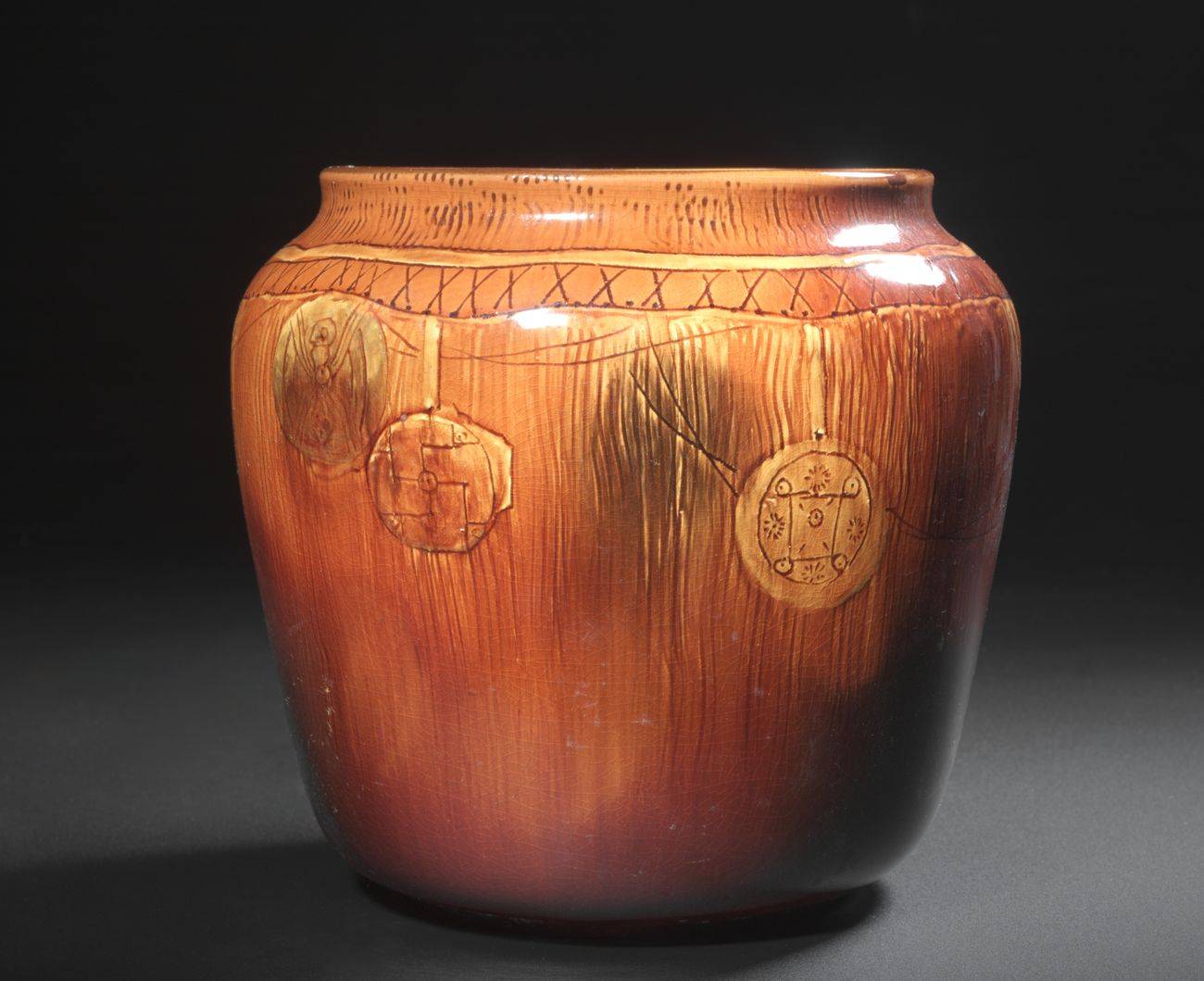
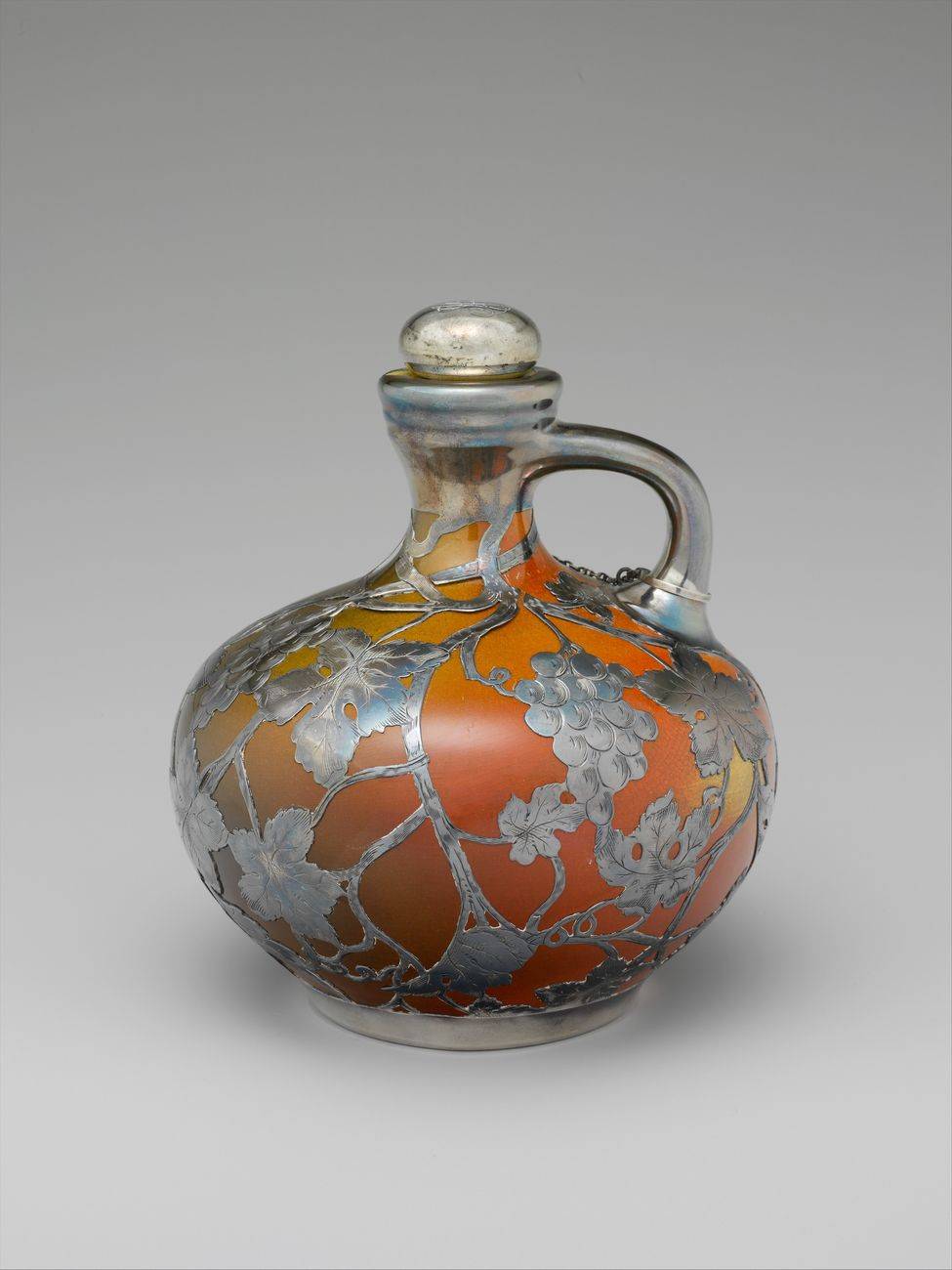
- Mug, 1892. The Met.
- Vase (decorated by Albert Robert Valentien), 1896. Art Institute of Chicago.
What could not be confirmed
- No allowed source opened states the exact year a flame point was first added, and the sources disagree (1887 or after 1888).
- No source opened covers Rookwood marks after 1901 beyond two dated museum examples; later numeral and anniversary-mark practice is not recorded.
- The marks of the revived company (from 2006) and of the 1940s owners are not covered.
Sources
- Marks of American Potters (Rookwood entry pp. 118-121). Patterson & White Company, Philadelphia (Edwin Atlee Barber), 1904. Opened 22 November 2026.
- The Rookwood Pottery Collection: Introduction. Richard and Carole Cocks Art Museum, Miami University. Opened 22 November 2026.
- Uncommon Clay: Ohio Art Pottery from the Paige Palmer Collection. Kent State University Museum, 2000. Opened 22 November 2026.
- Art Institute of Chicago public API, artwork 41487 (Vase, 1888), inscriptions field. Art Institute of Chicago. Opened 22 November 2026.
- Art Institute of Chicago public API, artwork 90898 (Bowl, 1915), inscriptions field. Art Institute of Chicago. Opened 22 November 2026.
- Art Institute of Chicago public API, artwork 57576 (Vase, 1926), inscriptions field. Art Institute of Chicago. Opened 22 November 2026.
Photograph the piece and its mark
Velqo gives a first identification from photos of the piece and its mark.