Royal Doulton marks
9 entries from 14 sources. 1 give a period of use stated by a source. The other 8 are marks seen on pieces of known date, which shows only that the mark was in use then.
Go to the marks

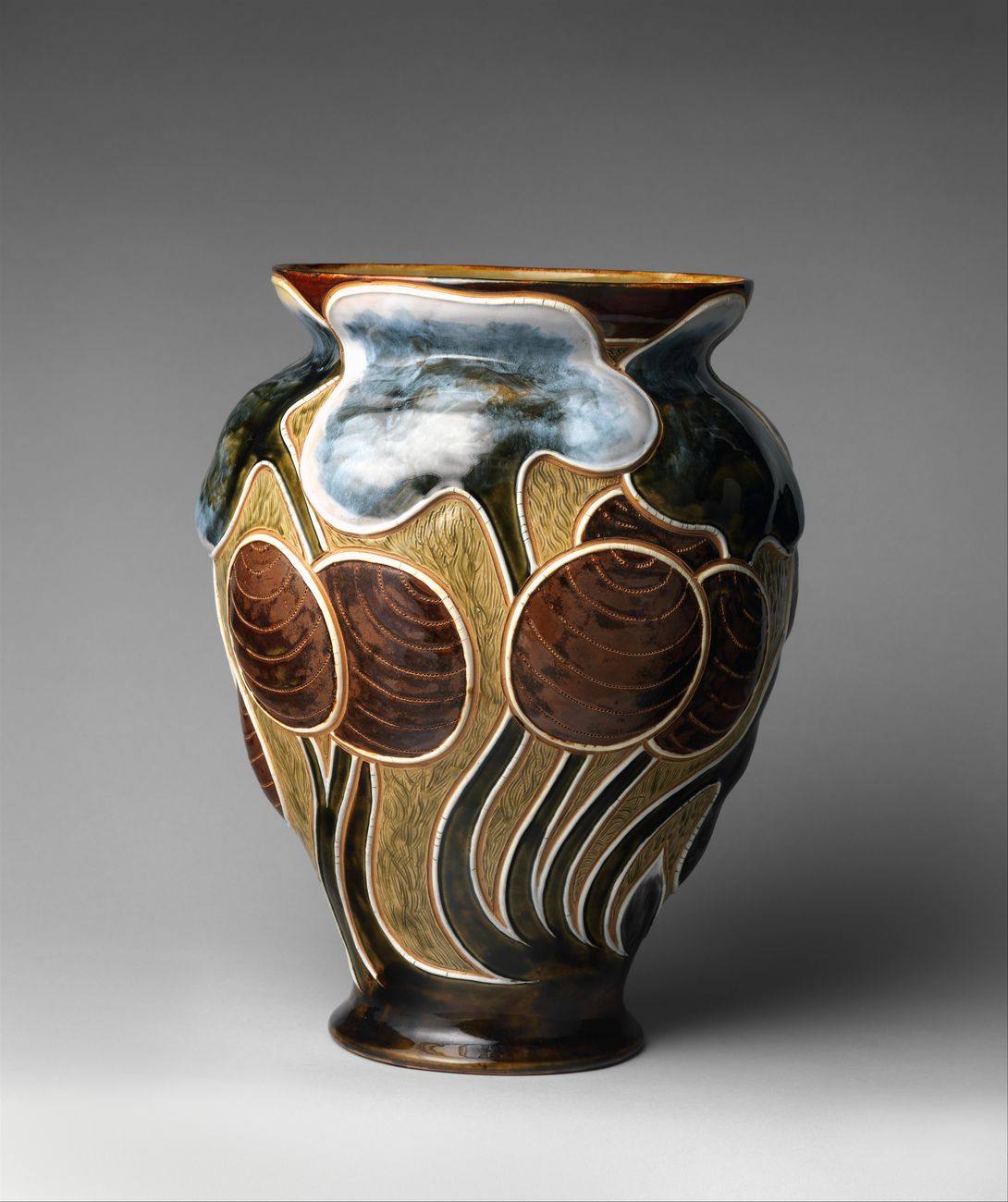
- Where Lambeth, England
- Founded Sources differ
- Made Salt-glazed stoneware
- Status Not confirmed
Founded: sources differ, see below. Status: no source here states the current status.
What the sources say
The V&A dates the start of Royal Doulton to 1815, when John Doulton made stoneware bottles and sewer pipes in Lambeth, London. (Source: the Victoria and Albert Museum)
Jewitt, writing in 1878, gives 1818 for John Doulton's stoneware works at Vauxhall, later in partnership with John Watts as Doulton & Watts, and says the works later moved to High Street, Lambeth. (Source: Llewellynn Jewitt (1878))
The V&A says the firm bought a factory in Burslem in 1882, added porcelain two years later and received a Royal Warrant in 1901. (Source: the Victoria and Albert Museum)
Lambeth stoneware is often marked with an impressed DOULTON LAMBETH medallion, and the V&A records examples from 1874 to 1888 carrying the year in the mark. (Sources: the Victoria and Albert Museum, records 1 and 2)
The V&A says the Lambeth factory closed in 1956. (Source: the Victoria and Albert Museum)
The marks
9 Royal Doulton entries
Each entry describes a mark in plain words, with how it was put on and the evidence for its date, in the words of its source.
-
Seen on a dated museum piece
Years: 1832
Impressed lettering reading Lambeth Pottery, Doulton and Watts, 15 High Street Lambeth (seen on a commemorative flask).
- How it was applied
- Pressed into the clay
- Date evidence
- Seen on a piece in the Victoria and Albert Museum, dated: ca. 1832. Open the source
“'Lambeth Pottery DOULTON & WATTS 15 HIGH STREET LAMBETH'”
-
Seen on a dated museum piece
Years: 1874
Impressed oval medallion reading DOULTON / LAMBETH with the year of making.
- How it was applied
- Pressed into the clay
- Date evidence
- Seen on a piece in the Victoria and Albert Museum, dated: 1874. Open the source
“'DOULTON / LAMBETH / 1874' within an oval”
-
Seen on a dated museum piece
Years: 1882
Impressed rosette with DOULTON, LAMBETH and the year, on an 1882 vase.
- How it was applied
- Pressed into the clay
- Date evidence
- Seen on a piece in the Victoria and Albert Museum, dated: 1882. Open the source
“A rosette and 'DOULTON, LAMBETH' and dated 1882”
-
Seen on a dated museum piece
Years: 1885
Four letter Ds forming a rebus, ringed by DOULTON / LAMBETH inside a wheel.
- How it was applied
- Pressed into the clay
- Date evidence
- Seen on a piece in the Victoria and Albert Museum, dated: ca. 1885. Open the source
“Rebus of four 'ds' surrounded by 'DOULTON / LAMBETH' [within a wheel]”
-
Seen on a dated museum piece
Years: 1888
Impressed DOULTON / SILICON / WARE in an oblong panel, with the year 1888.
- How it was applied
- Pressed into the clay
- Date evidence
- Seen on a piece in the Victoria and Albert Museum, dated: 1888. Open the source
“'DOULTON / SILICON / WARE' in an oblong compartment and '1888'”
-
Seen on a dated museum piece
Years: 1885
Printed DOULTON BURSLEM (Burslem example).
- How it was applied
- Printed
- Date evidence
- Seen on a piece in the Victoria and Albert Museum, dated: ca. 1885 (V&A record date for this object). Open the source
“'Doulton Burslem'”
-
Seen on a dated museum piece
Years: 1902 to 1922
Impressed lion standing on a crown above ROYAL DOULTON / ENGLAND, on a Lambeth stoneware vase.
- How it was applied
- Pressed into the clay
- Date evidence
- Seen on a piece in the Victoria and Albert Museum, dated: ca. 1902-1922 (V&A record date for this object). Open the source
“Lion, crown and 'ROYAL DOULTON / ENGLAND'”
-
Period stated by the source
Years: 1902 to 1956
ROYAL . DOULTON / ENGLAND as a border round an interlocking semicircle motif; the V&A note gives a period of use for smaller pots.
- How it was applied
- Pressed into the clay
- Date evidence
- The Victoria and Albert Museum gives this mark as: Mark in use on smaller pots 1902-1956. Open the source
“Mark in use on smaller pots 1902-1956 ( Eyles, Desmond, The Doulton Lambeth Wares, Richard Dennis, 2002. p325)”
-
Seen on a dated museum piece
Years: 1934 to 1939
Printed ROYAL DOULTON / ENGLAND in a circle round a geometric device, with MADE IN ENGLAND, a lion on a crown, and a Rd No (registered design number).
- How it was applied
- Printed, in green
- Date evidence
- Seen on a piece in the Victoria and Albert Museum, dated: ca. 1934 - 1939. Open the source
“'ROYAL DOULTON / ENGLAND' in circular form around a geometrical device, above which 'MADE IN ENGLAND' and a crown surmounted by a lion, and below which 'Rd No 782778', printed in green, on base.”
Dating clues
- The Lambeth oval medallion mark carried the year of making in the 1870s examples the V&A records, so those pieces can be dated from the mark itself. (Source: the Victoria and Albert Museum)
- HN numbers on Royal Doulton figures date from 1913, according to the V&A note on a figurine. (Source: the Victoria and Albert Museum)
Take care
- Sources disagree on the start date: Jewitt (1878) gives 1818 for John Doulton's stoneware works at Vauxhall; the V&A gives 1815 for Lambeth. (Source: Llewellynn Jewitt (1878))
Where sources differ
Both sides are shown with their sources. Neither is picked as right.
- Start date of the Doulton business.
- Royal Doulton began in Lambeth, London, in 1815. (Source: the Victoria and Albert Museum)
- In 1818 John Doulton established stoneware works at Vauxhall, later moved to High Street, Lambeth. (Source: Llewellynn Jewitt (1878))
In museum collections
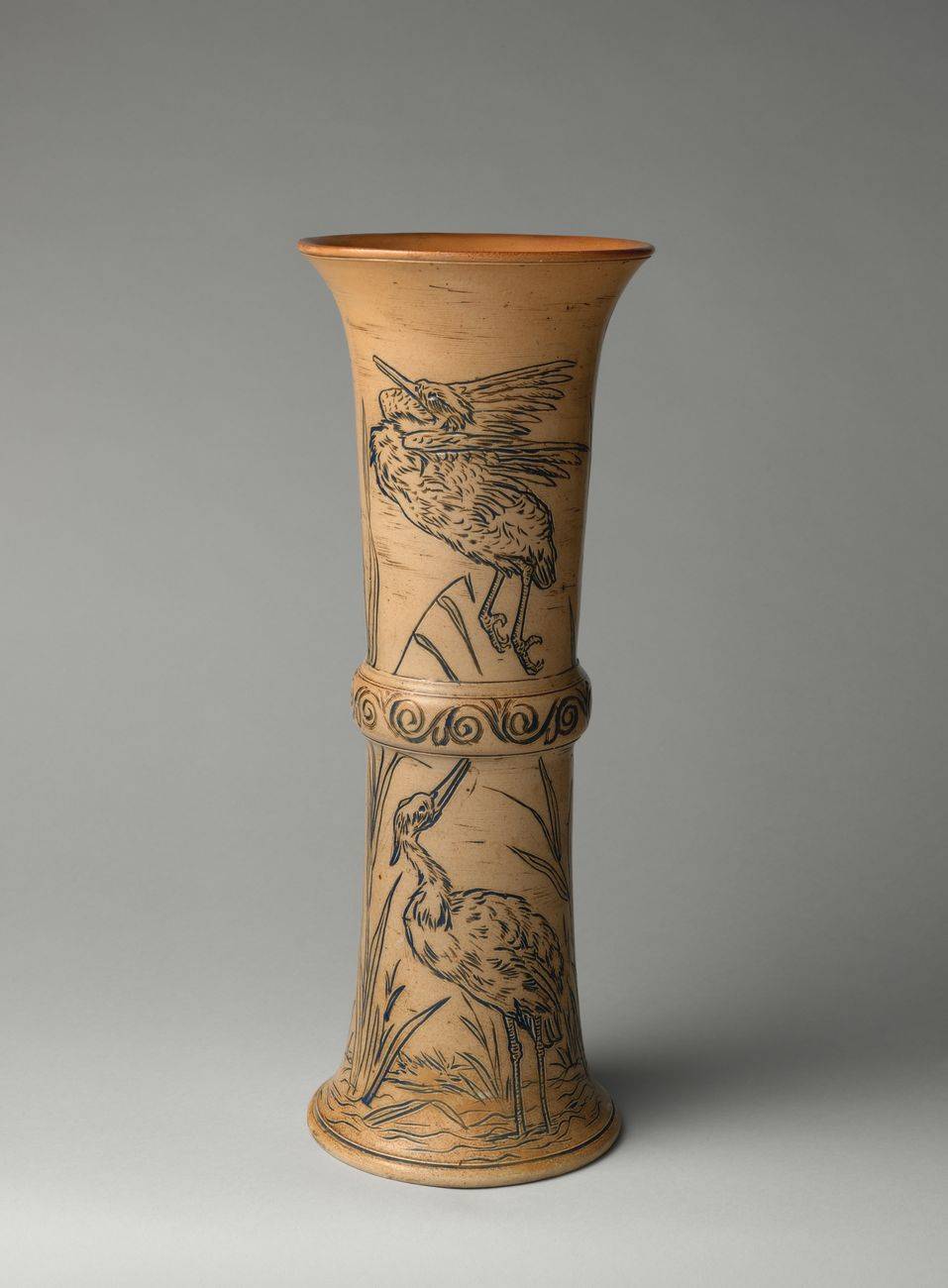
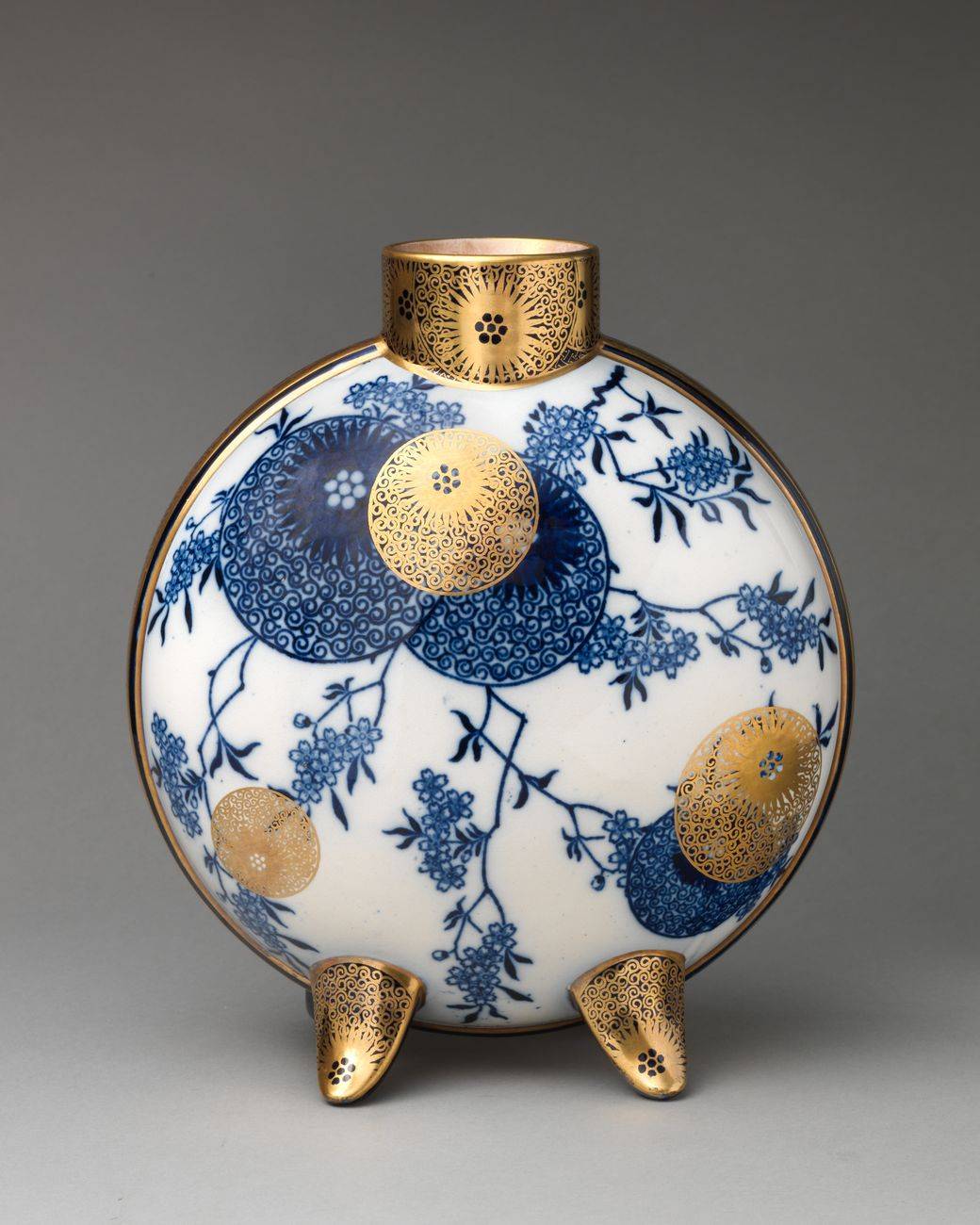
- Moon flask with pink flower motif, 1882-1891. The Met.
What could not be confirmed
- No trade-mark register entry or official Royal Doulton backstamp guide was opened, so the start and end years of each printed mark are not independently stated.
- The Burslem period before 1882 is not covered: the V&A and Met records disagree or are silent (a Met bulletin snippet seen in search gave 1878 for the merger with Pinder Bourne, not opened in full).
- The Lambeth stoneware dated medallion is recorded only as dated examples (1874 to 1888), not as a stated range of use.
- No primary source opened gives the firm's current ownership or trading status (the V&A gives 1956 for the closure of the Lambeth factory only).
Sources
- V&A Collections record 355-1874. Victoria and Albert Museum. Opened 22 November 2026.
- V&A Collections record 3783-1901. Victoria and Albert Museum. Opened 22 November 2026.
- V&A Collections record C.17-1975. Victoria and Albert Museum. Opened 22 November 2026.
- V&A Collections record C.53-1985. Victoria and Albert Museum. Opened 22 November 2026.
- V&A Collections record C.27-1972. Victoria and Albert Museum. Opened 22 November 2026.
- V&A Collections record C.28-1970. Victoria and Albert Museum. Opened 22 November 2026.
- V&A Collections record C.63-2012. Victoria and Albert Museum. Opened 22 November 2026.
- V&A Collections record C.131-2012. Victoria and Albert Museum. Opened 22 November 2026.
- V&A Collections record S.921-1981. Victoria and Albert Museum. Opened 22 November 2026.
- V&A Collections record S.1433-1986. Victoria and Albert Museum. Opened 22 November 2026.
- V&A Collections record 3804-1901. Victoria and Albert Museum. Opened 22 November 2026.
- V&A Collections record C.54-1972. Victoria and Albert Museum. Opened 22 November 2026.
- The Ceramic Art of Great Britain, vol. 1. Llewellynn Jewitt, London, 1878. Opened 22 November 2026.
- The Met Collection API search for Doulton Manufactory. The Metropolitan Museum of Art. Opened 22 November 2026.
Photograph the piece and its mark
Velqo gives a first identification from photos of the piece and its mark.