Royal Worcester marks
17 entries from 10 sources. 11 give a period of use stated by a source. The other 6 are marks seen on pieces of known date, which shows only that the mark was in use then.
Go to the marks

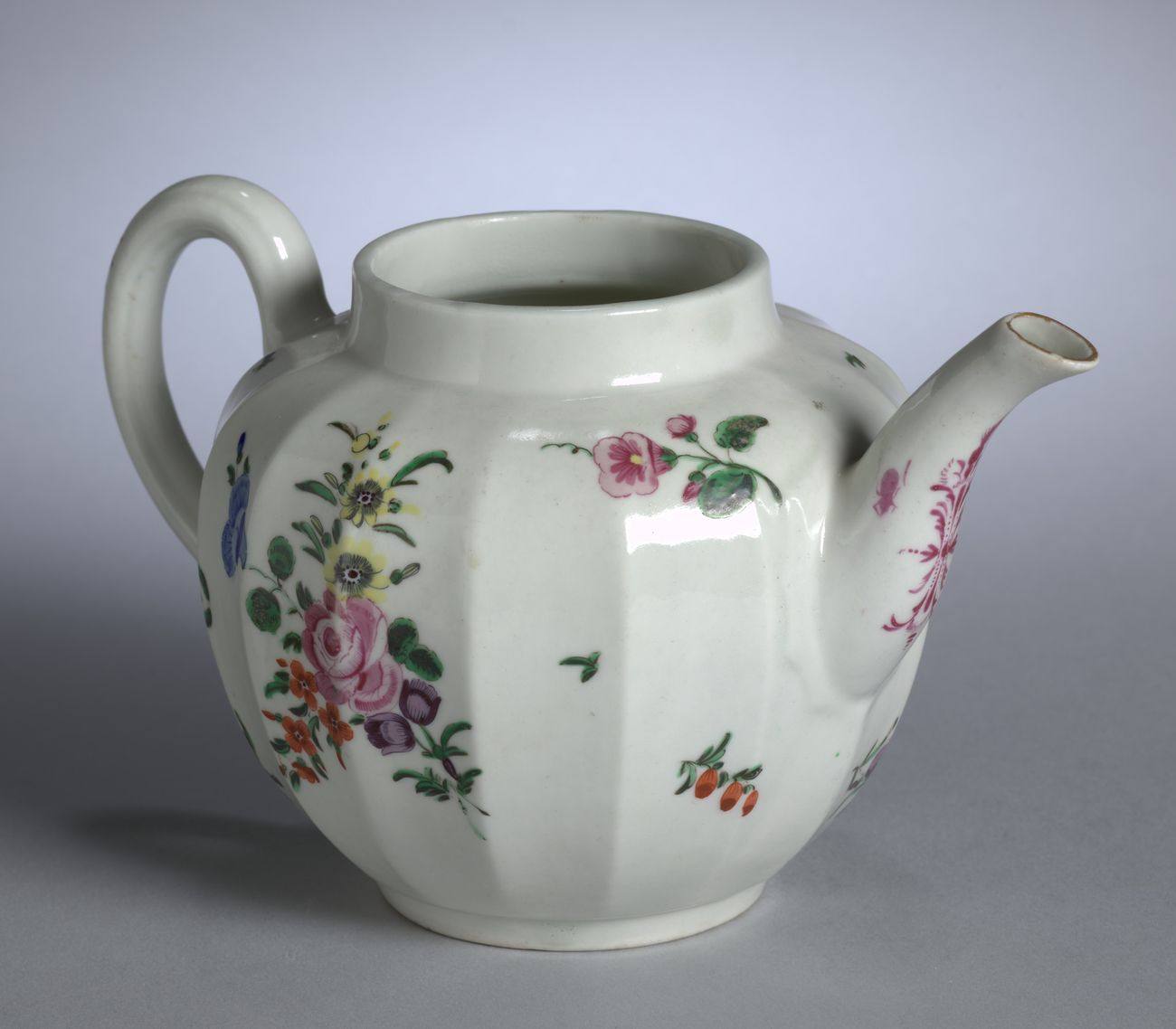
- Where Worcester, England
- Founded 1751
- Made Soft-paste porcelain
- Status Closed 2008
Founded 1751: (Source: the Museum of Royal Worcester). Status: closed. (Source: the Museum of Royal Worcester)
What the sources say
The Museum of Royal Worcester says the Worcester Porcelain Company was founded by Dr John Wall in 1751 and that the Worcester Royal Porcelain Co Ltd was formed in 1862. (Source: the Museum of Royal Worcester)
Chaffers (1912) says the Flights bought the works in 1783 and that after a royal visit in 1788 the crown was added to the mark; the firm then traded as Flight and Barr and Barr, Flight and Barr until 1840. (Source: W. Chaffers, 1912 edition)
The museum gives a year-by-year code for the standard printed Royal Worcester mark: two figures or a letter from 1862 to 1890, dots from 1892 to 1915, a star from 1916, then changing shapes. (Source: the Museum of Royal Worcester)
Eighteenth century pieces may carry a crescent, a fretted or square seal mark, an imitation of the Meissen crossed swords with a number, or workmen's signs, and often carry no mark at all. (Sources: W. Chaffers, 1912 edition and the Victoria and Albert Museum, records 1, 2 and 3)
Other firms made porcelain in Worcester at the same time, including Chamberlain from 1789 and Grainger from 1801, so a Worcester address is not always Royal Worcester. (Sources: Burton and Hobson (1919) and W. Chaffers, 1912 edition)
The marks
17 Royal Worcester entries
Each entry describes a mark in plain words, with how it was put on and the evidence for its date, in the words of its source.
-
Period stated by the source
Years: until 1793
A crescent shape drawn in outline, usually in underglaze blue, on early Worcester porcelain.
- How it was applied
- Painted by hand, in blue
- Date evidence
- W. Chaffers, 1912 edition gives this mark as: frequently used, together with other marks, down to 1793, but not after. Open the source
“a crescent outlined in blue, frequently used, together with other marks, down to 1793, but not after”
-
Period stated by the source
A filled-in crescent (as opposed to an outline), which Chaffers says is found on blue printed wares while the outline is found on painted wares.
- How it was applied
- Printed, in blue
- Date evidence
- W. Chaffers, 1912 edition gives this mark as: Chaffers gives no date for this rule. Open the source
“the painted are distinguished from the printed by having, as a rule, the open or outlined crescent on the former and the filled-in crescent on the latter.”
-
Seen on a dated museum piece
Years: 1770
A hatched crescent on the base of a jug.
- How it was applied
- Painted by hand
- Date evidence
- Seen on a piece in the Victoria and Albert Museum, dated: ca. 1770. Open the source
“A hatched crescent”
-
Seen on a dated museum piece
Years: 1750 to 1770
A blue half moon mark on the bottom of a fruit bowl.
- How it was applied
- Painted by hand, in blue
- Date evidence
- Seen on a piece in the Cleveland Museum of Art, dated: Cleveland dates the object c. 1750-70. Open the source
“Blue half moon mark on bottom”
-
Seen on a dated museum piece
Years: 1770
A fretted square (a square seal-like mark) on the base of a teapot.
- How it was applied
- Painted by hand
- Date evidence
- Seen on a piece in the Victoria and Albert Museum, dated: ca. 1770. Open the source
“A fretted square”
-
Seen on a dated museum piece
Years: 1755 to 1775
An X with radiating lines inside a box on the bottom of a teapot.
- How it was applied
- Painted by hand
- Date evidence
- Seen on a piece in the Cleveland Museum of Art, dated: Cleveland dates the object c. 1755-75. Open the source
“Mark on the bottom - An X with radiating lines inside a box.”
-
Seen on a dated museum piece
Years: 1760
Crossed swords in blue with the figure 9 in blue, copying the Meissen mark.
- How it was applied
- Painted by hand, in blue
- Date evidence
- Seen on a piece in the Victoria and Albert Museum, dated: ca. 1760. Open the source
“Crossed swords, in blue | '9' in blue”
-
Period stated by the source
Years: 1793 to 1803
The letter B scratched or indented into the clay, for Martin Barr.
- How it was applied
- Scratched into the clay
- Date evidence
- W. Chaffers, 1912 edition gives this mark as: found indented on pieces of this ware between 1793 and 1803. Open the source
“This letter is found indented on pieces of this ware between 1793 and 1803”
-
Period stated by the source
Years: 1807 to 1813
The letters B. F. B. with a crown above, impressed in the ware without colour.
- How it was applied
- Pressed into the clay
- Date evidence
- W. Chaffers, 1912 edition gives this mark as: Messrs. Barr, Flight & Barr, 1807 to 1813. Open the source
“The letters B. F. B., with a crown above, impressed on the ware without colour.”
-
Seen on a dated museum piece
Years: 1807 to 1813
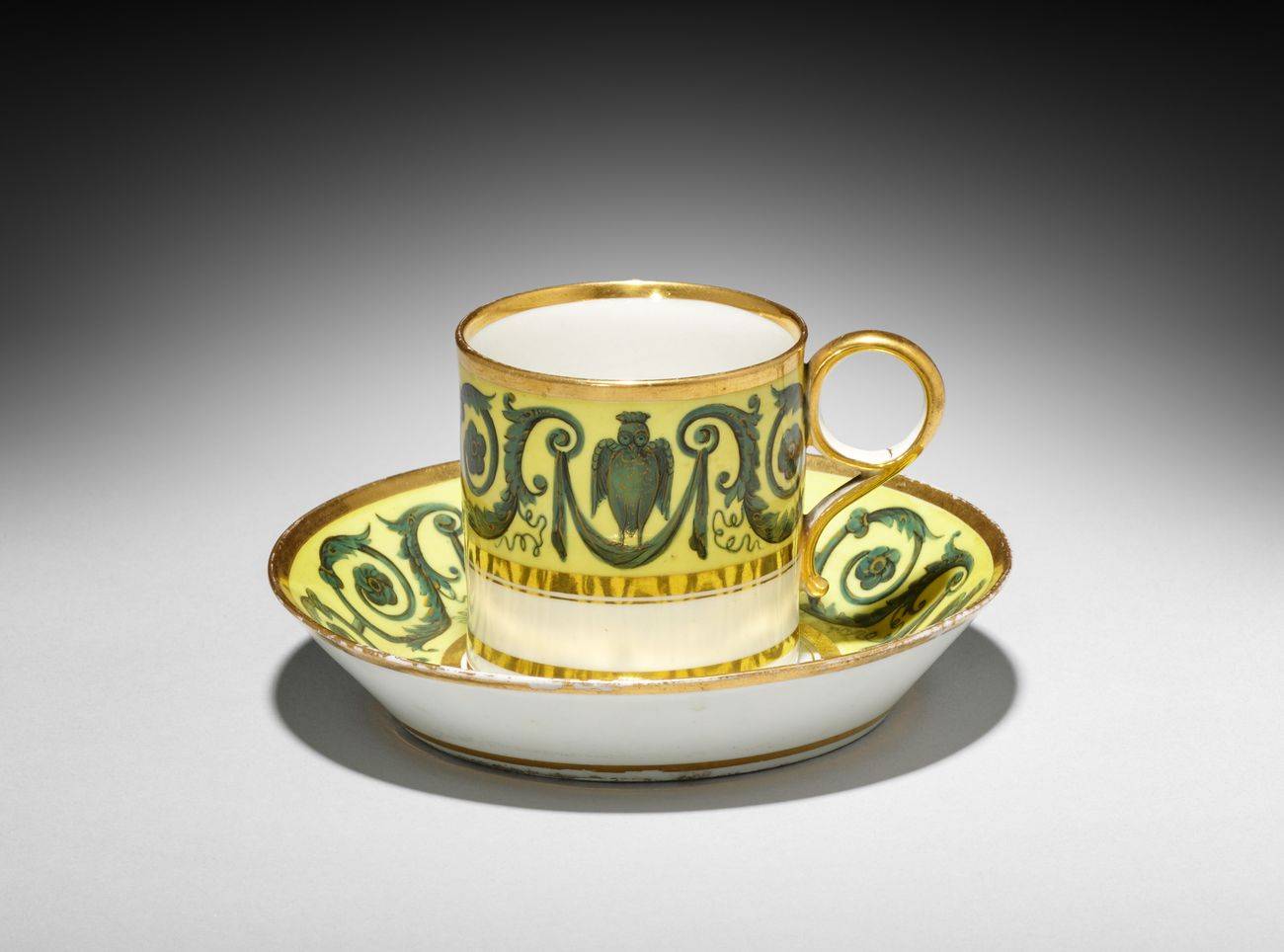
The words Barr, Flight and Barr, Royal Porcelain Works, Worcester, London House, Flight and Barr, Coventry Street, in overglaze red, surrounded by Manufacturers to their Majesties Prince of Wales and Royal Family, Established 1751.
- How it was applied
- Painted by hand, in overglaze red
- Date evidence
- Seen on a piece in the Cleveland Museum of Art, dated: Cleveland dates the cup and saucer 1807-13. Open the source
“in overglaze red: "Barr, Flight and Barr/ Royal Porcelain Works/ Worcester/ London -- House/ Flight & Barr/ Coventry Street," surrounded by: "Manufacturers to their Majesties Prince of Wales and Royal Family. Established 1751."”
-
Period stated by the source
Years: from 1862
The Royal Worcester circle mark with a crown above and the number 51 in the centre, printed in any colour.
- How it was applied
- Printed, in any colour
- Date evidence
- W. Chaffers, 1912 edition gives this mark as: Present mark since 1862. Open the source
“Present mark since 1862,”
-
Period stated by the source
Years: 1862 to 1875
The last two figures of the year (for example 75 for 1875) printed below the standard mark.
- How it was applied
- Printed, in any colour
- Date evidence
- The Museum of Royal Worcester gives this mark as: Between 1862 and 1875 ... the last two figures of the date, eg 75 for 1875. Open the source
“Between 1862 and 1875 specific indications of the year of manufacture are rare but may sometimes be found in the form of the last two figures of the date, eg 75 for 1875, printed below the standard mark.”
-
Period stated by the source
Years: 1867 to 1890
A single capital letter below the circle mark, A for 1867 running to O for 1889 and a lower case a for 1890 (the letter list skips F, J and Q).
- How it was applied
- Printed, in any colour
- Date evidence
- The Museum of Royal Worcester gives this mark as: From 1867 a letter system was also used; A = 1867 ... a = 1890. Open the source
“From 1867 a letter system was also used to indicate the year of manufacture. From 1876 the crown sits down to fit the circle. A = 1867 B = 1868 C = 1869 D = 1870 E = 1871 G = 1872 H = 1873 I = 1874 K = 1875 L = 1876 M = 1877 N = 1878 P = 1879 R = 1880 S = 1881 T = 1882 U = 1883 V = 1884 W = 1885 X = 1886 Y = 1887 Z = 1888 O = 1889 a = 1890”
-
Period stated by the source
Years: 1891 to 1915
Tiny dots added to the circle mark, with the words Royal Worcester England: one dot for 1892, two for 1893, and so on up to 24 dots in 1915.
- How it was applied
- Printed, in any colour
- Date evidence
- The Museum of Royal Worcester gives this mark as: 1891 = 'Royal Worcester England' added; 1892 = One dot; ... until 1915 when 24 dots. Open the source
“From 1891 pieces were coded with a system of dots and/or symbols with the addition of the words ‘Royal Worcester England’. 1891 = ‘Royal Worcester England’ added 1892 = One dot 1893 = Two dots 1894 = Three dots This system continued until 1915 when 24 dots are arranged around the standard printed mark.”
-
Period stated by the source
Years: 1916 to 1927
A small star or asterisk below the mark in 1916, then an extra dot each year until 11 dots in 1927.
- How it was applied
- Printed, in any colour
- Date evidence
- The Museum of Royal Worcester gives this mark as: From 1916 a small star or asterisk appears below the mark. Open the source
“From 1916 a small star or asterisk appears below the mark. 1916 = * below the mark 1917 = * and one dot 1918 = * and two dots An extra dot was added each year until 1927 when 11 dots are arranged around the standard printed mark.”
-
Period stated by the source
Years: 1928 to 1941
An oblong (1928), diamond (1929), division mark (1930), two circles (1931) and three circles (1932), then dots added to the three circles, all with the words Made in England.
- How it was applied
- Printed, in any colour
- Date evidence
- The Museum of Royal Worcester gives this mark as: 1928 = Oblong shape ... continued until 1941 when there were 9 dots and the triple circle mark. Open the source
“1928 = Oblong shape and the words ‘Made in England’ added 1929 = Diamond shape and Made in England 1930 = Division mark and Made in England 1931 = Two circles and Made in England 1932 = Three circles and Made in England”
-
Period stated by the source
Years: 1949 to 1956
The letter V (1949) and then W (1950 onwards) with dots added each year to 1956, after a gap from 1942 to 1948 with no code.
- How it was applied
- Printed, in any colour
- Date evidence
- The Museum of Royal Worcester gives this mark as: 1949 = the letter V was introduced, ENGLAND added ... 1956 = the letter W or R in a circle ... (with six dots). Open the source
“Between 1942 and 1948 no date code was used in the mark. 1949 = the letter V was introduced, ENGLAND added 1950 = the letter W”
Dating clues
- The museum says the printed Royal Worcester mark almost always includes a year code, and that the 51 in the centre stands for the founding year 1751, not the year of manufacture. (Source: the Museum of Royal Worcester)
- The museum says from the mid 1960s a different stamp was used on bone china tableware and the date it carries is the year the design was introduced, not the year of manufacture. (Source: the Museum of Royal Worcester)
- Chaffers says the Worcester marks are of great variety but historically denote changes in direction of the factory, so they help date particular pieces. (Source: W. Chaffers, 1912 edition)
- Chaffers says that after the King's visit of 1788 the works were called the Royal Worcester Porcelain Works and the crown was added to the mark. (Source: W. Chaffers, 1912 edition)
Take care
- Chaffers says the Worcester makers copied the marks of most of the celebrated factories in their turn, including the Oriental marks, the Dresden caduceus and crossed swords, and sometimes the Chelsea mark. (Source: W. Chaffers, 1912 edition)
- Chaffers says pieces of the same service are sometimes found with different marks, and that excellent Worcester is frequently unmarked. (Source: W. Chaffers, 1912 edition)
- The museum says separate mark systems have been used since the 1880s for earthenware (crownware) and Royal Worcester Vitreous, and that hard porcelain rarely has any code. (Source: the Museum of Royal Worcester)
- Burton and Hobson list Chamberlain's Worcester factory as a separate maker, 1789 to 1840, with its own marks. (Source: Burton and Hobson (1919))
- Chaffers says a third china factory was established in Worcester in 1800 by Thomas Grainger, later Grainger, Wood and Co. and Grainger, Lee and Co. (Source: W. Chaffers, 1912 edition)
Where sources differ
Both sides are shown with their sources. Neither is picked as right.
- Start of the Grainger factory.
- A third china manufactory was established in St. Martin's Street by Thomas Grainger in 1800. (Source: W. Chaffers, 1912 edition)
- Grainger's factory 1801-1888. (Source: Burton and Hobson (1919))
- Dates of the Flight period marks.
- Flight marks used from 1783 until 1788, and the mark used after the King's visit from 1788 until 1792; Flight and Barr from 1793 to 1807. (Source: W. Chaffers, 1912 edition)
- Flight period 1783-93; Flight & Barr 1793-1807. (Source: Burton and Hobson (1919))
In museum collections
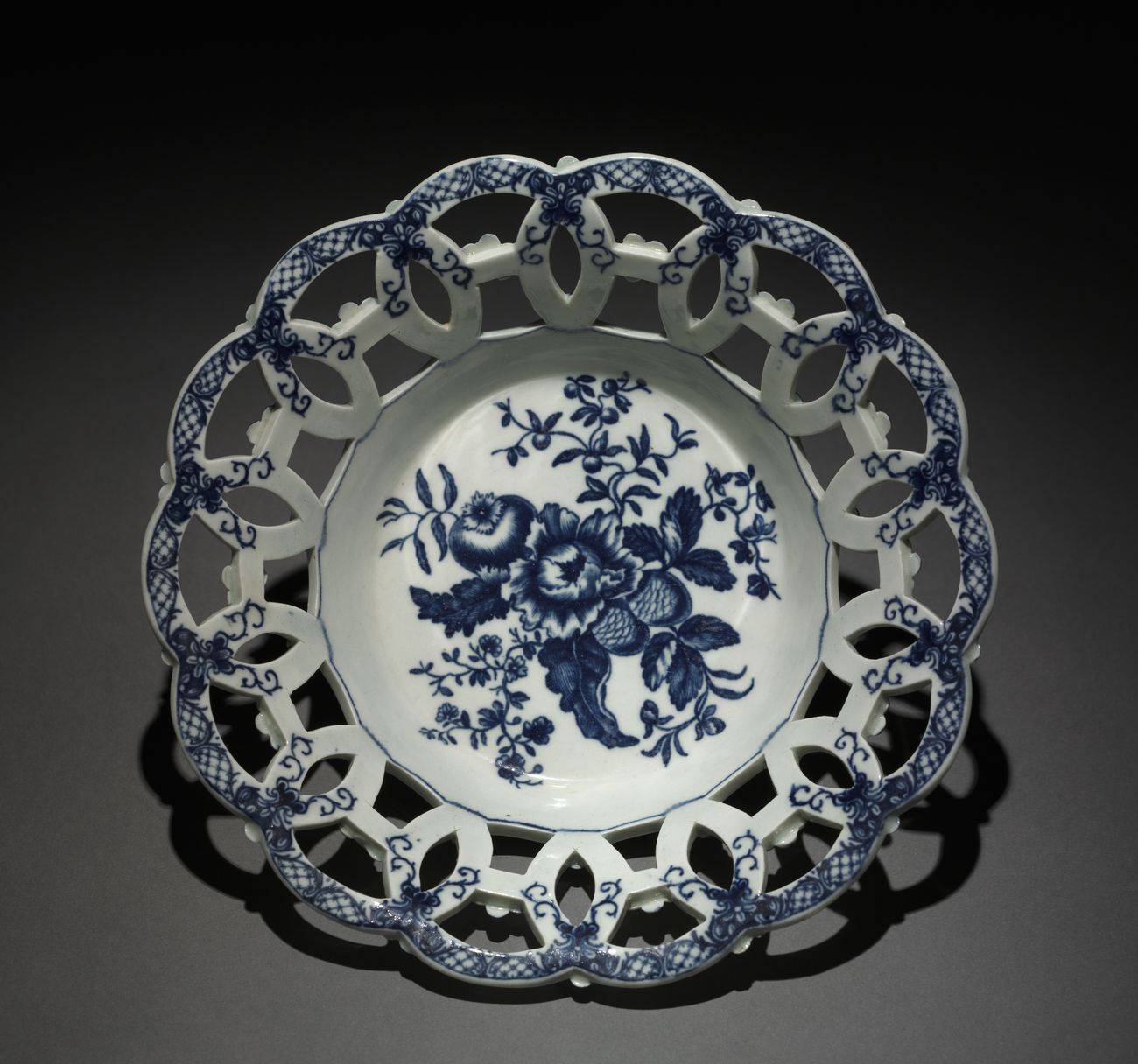
- Plate with Peony Decoration, 1765. Cleveland Museum of Art.
- Vase, 1873. Cleveland Museum of Art.
What could not be confirmed
- The museum describes the year codes in words; its drawings of the marks are not reproduced here.
- The museum's letter list for 1867 to 1890 leaves out F, J and Q and does not say why.
- The museum gives two-figure years from 1862 but a letter system only from 1867, and says 1891 added the words Royal Worcester England with the first dot in 1892.
- No source used here gives dated marks for the separate Chamberlain and Grainger factories beyond their periods of work.
- Marks after 1956 (dots round an R in a circle, a new tableware stamp from the mid 1960s, and the 1988 to 2006 year codes) are described by the museum but not set out here as separate marks.
- No source used here says whether the crescent or the square seal mark came first; the seal mark is known only from dated pieces of about 1770.
Sources
- Handbook of Marks on Pottery and Porcelain (Burton and Hobson). Macmillan (scan of the archive.org copy listed as 1919; first edition 1909), 1919. Opened 22 November 2026.
- Marks and Monograms on European and Oriental Pottery and Porcelain (W. Chaffers, 1912 edition). Reeves and Turner, London, 1912. Opened 22 November 2026.
- Teapot, c. 1755–75 (accession 2009.108.a). Cleveland Museum of Art (Open Access, CC0). Opened 22 November 2026.
- Fruit Bowl, c. 1750–70 (accession 2009.99). Cleveland Museum of Art (Open Access, CC0). Opened 22 November 2026.
- Cup and Saucer, 1807–13 (accession 1919.185). Cleveland Museum of Art (Open Access, CC0). Opened 22 November 2026.
- Museum of Royal Worcester home page. Museum of Royal Worcester (The Dyson Perrins Museum Trust). Opened 22 November 2026.
- Royal Worcester factory marks. Museum of Royal Worcester (The Dyson Perrins Museum Trust). Opened 22 November 2026.
- Teapot and cover, Worcester, ca. 1770 (museum no. O182643). Victoria and Albert Museum. Opened 22 November 2026.
- Cup and saucer, Worcester, ca. 1760 (museum no. O336862). Victoria and Albert Museum. Opened 22 November 2026.
- Jug, Worcester, ca. 1770 (museum no. O71471). Victoria and Albert Museum. Opened 22 November 2026.
Photograph the piece and its mark
Velqo gives a first identification from photos of the piece and its mark.