Sèvres marks
17 entries from 12 sources. 8 give a period of use stated by a source. The other 9 are marks seen on pieces of known date, which shows only that the mark was in use then.
Go to the marks

- Where Vincennes, France
- Founded 1740
- Made Soft-paste porcelain
- Status Not confirmed
Founded 1740: (Source: the Victoria and Albert Museum). Status: not stated.
What the sources say
The V&A says the factory was founded in 1740 in the royal chateau of Vincennes, was moved to Sèvres in 1756 and was bought by Louis XV shortly afterwards. (Source: the Victoria and Albert Museum)
Chaffers (1912) says a decree of 19 November 1753 directed the use of a date letter together with the double L mark. (Source: W. Chaffers, 1912 edition)
Single date letters run from A for 1753; Chaffers says the double letters began in 1778 and ended in 1795 with RR, while Burton and Hobson's table stops at PP for 1793 and says letters were rare from 1793 to 1800. (Sources: Burton and Hobson (1919) and W. Chaffers, 1912 edition)
Museum records for dated pieces generally fit that scheme, but a few letters sit a year away from the handbook table and a 2014 study cited by the V&A has moved the letter D to 1757. (Sources: the Victoria and Albert Museum, records 1 and 2 and Burton and Hobson (1919))
After the Revolution the factory used republican, imperial and royal marks in turn, and from 1818 the year was given as the last two figures and later in full. (Sources: W. Chaffers, 1912 edition and Burton and Hobson (1919))
The marks
17 Sèvres entries
Each entry describes a mark in plain words, with how it was put on and the evidence for its date, in the words of its source.
-
Period stated by the source
Years: until 1753
The letter L (described by Chaffers as reversed), sometimes with a dot between the letters and sometimes without, on Vincennes pieces.
- How it was applied
- Painted by hand
- Date evidence
- W. Chaffers, 1912 edition gives this mark as: appears on specimens previous to 1753. Open the source
“The King had allowed the reversed " L " to be used as a mark, and this appears on specimens previous to 1753, sometimes with a dot between the letters and sometimes without.”
-
Period stated by the source
Years: 1753 to 1777
Two L's interlaced, with a single letter of the alphabet enclosed between them as the date letter (A for 1753, B for 1754 and so on).
- How it was applied
- Painted by hand, in blue enamel on the pieces recorded by museums
- Date evidence
- W. Chaffers, 1912 edition gives this mark as: 1753 is marked by the letter A, 1754 by B, and so on; double letters begin in 1778. Open the source
“In 1753 the use of the letters of the alphabet commenced to indicate the date, thus 1753 is marked by the letter A, 1754 by B, and so on.”
-
Period stated by the source
Years: from 1753
The same interlaced L's with date letter, introduced by a royal decree.
- How it was applied
- Painted by hand
- Date evidence
- W. Chaffers, 1912 edition gives this mark as: On the 19th November of that year a decree of the King directed their use. Open the source
“On the 19th November of that year a decree of the King directed their use, in conjunction with the double L.”
-
Period stated by the source
Years: 1778 to 1795
Two L's interlaced enclosing a doubled date letter (AA, BB, CC and so on).
- How it was applied
- Painted by hand
- Date evidence
- W. Chaffers, 1912 edition gives this mark as: The double letters were used in 1778 and ended in 1795 with RR. Open the source
“The double letters were used in 1778 and ended in 1795 with RR”
-
Seen on a dated museum piece
Years: 1754
Interlaced L's in blue enamel with the date letter A and four dots, on a Vincennes piece.
- How it was applied
- Painted by hand, in blue enamel
- Date evidence
- Seen on a piece in the Victoria and Albert Museum, dated: V&A object date 1754. Open the source
“Interlaced 'L's in blue enamel with date letter 'A' and four dots”
-
Seen on a dated museum piece
Years: 1757
Interlaced L's in pink enamel with the date letter D, on a mustard pot.
- How it was applied
- Painted by hand, in pink enamel
- Date evidence
- Seen on a piece in the Victoria and Albert Museum, dated: 1757 (made); the record says D is now for 1757, not 1756-7 as formerly thought. Open the source
“Interlaced 'L's in pink enamel with date letter 'D'”
-
Seen on a dated museum piece
Years: 1756 to 1757
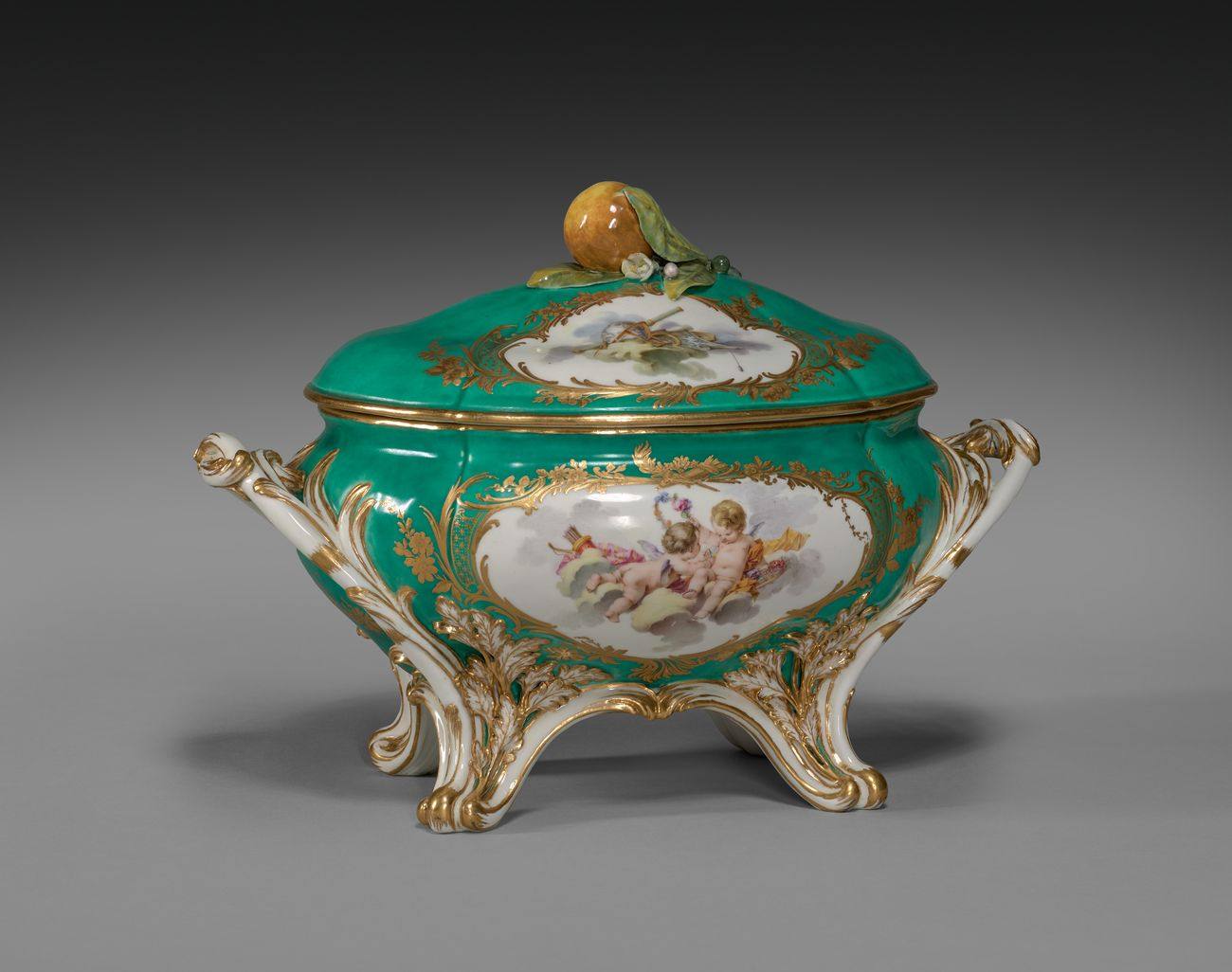
Interlaced L's with the date letter D in cursive between a dot on either side, on a tureen.
- How it was applied
- Painted by hand
- Date evidence
- Seen on a piece in the Cleveland Museum of Art, dated: Cleveland dates the object 1756-57. Open the source
“Date letter 'D' (in cursive with a dot on either side)”
-
Seen on a dated museum piece
Years: 1757 to 1758
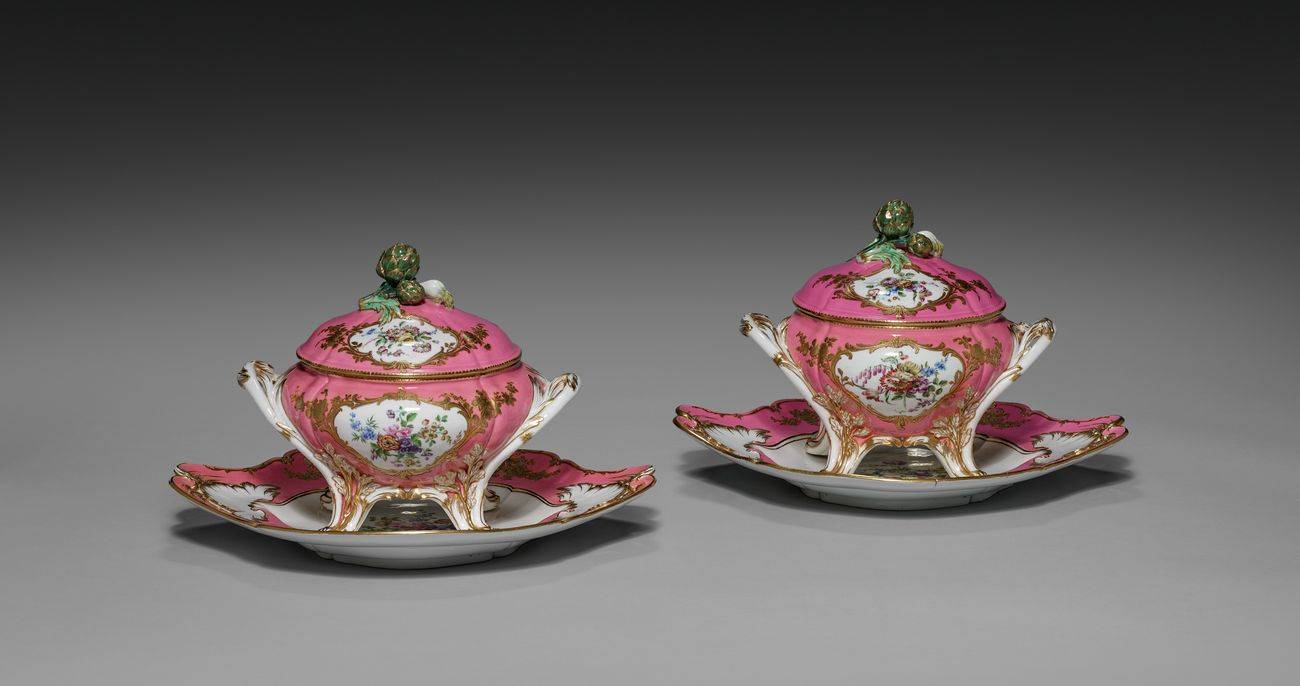
Interlaced L's in blue with the date letter E, on a pair of tureens.
- How it was applied
- Painted by hand, in blue
- Date evidence
- Seen on a piece in the Cleveland Museum of Art, dated: Cleveland dates the objects 1757-58. Open the source
“Interlaced 'L's in blue with date letter 'E'”
-
Seen on a dated museum piece
Years: 1760
Crossed (interlaced) L's enclosing the date letter G, on a cuvette.
- How it was applied
- Painted by hand
- Date evidence
- Seen on a piece in the Victoria and Albert Museum, dated: V&A: date letter G for 1760 ('G' was formerly thought to denote 1759-60). Open the source
“crossed Ls enclosing date letter G for 1760”
-
Seen on a dated museum piece
Years: 1765
Interlaced L's enclosing the date letter m, on a porcelain plaque.
- How it was applied
- Painted by hand
- Date evidence
- Seen on a piece in the Victoria and Albert Museum, dated: V&A object date 1765. Open the source
“Interlaced 'L's enclosing date letter 'm'”
-
Seen on a dated museum piece
Years: 1772
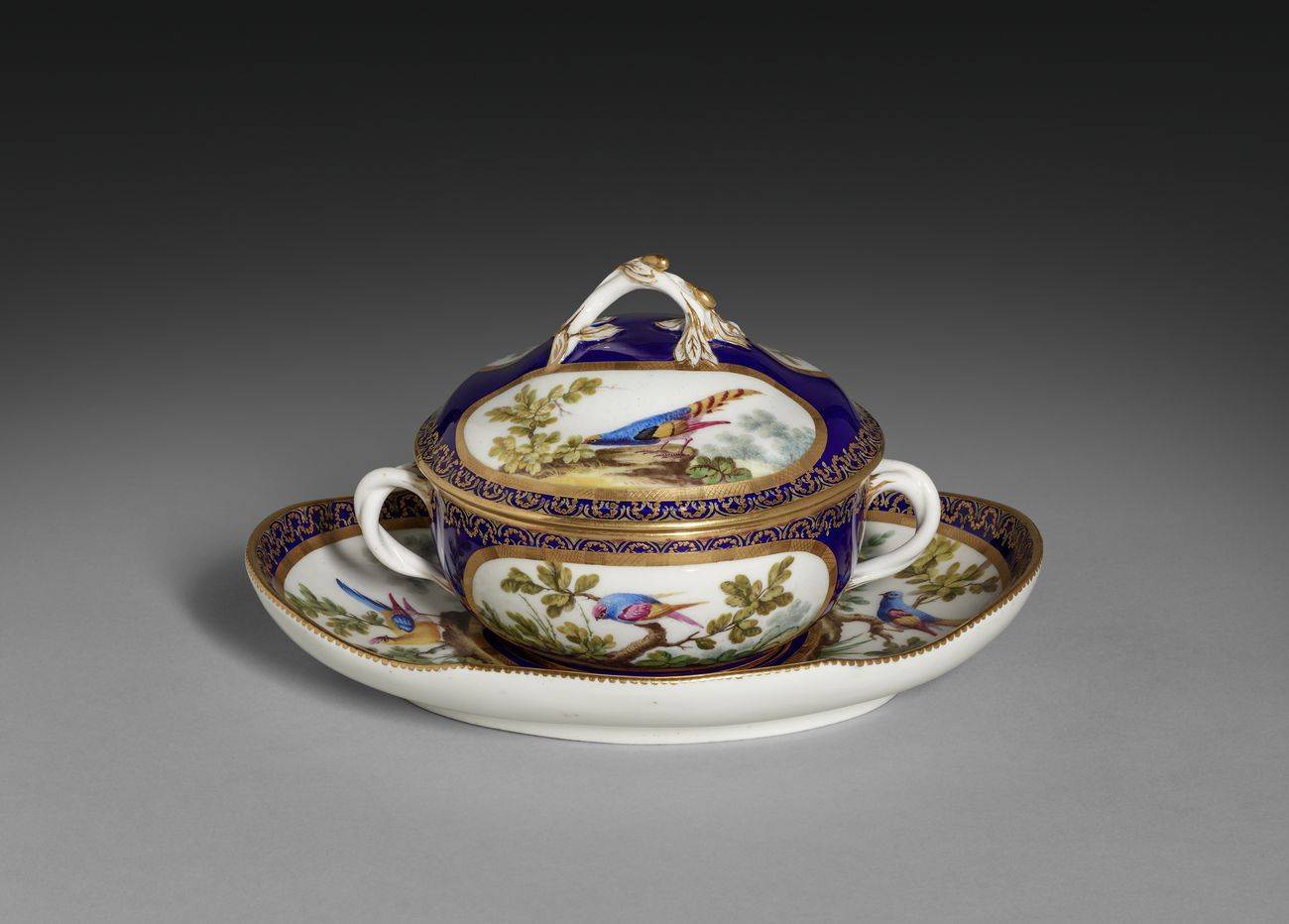
Interlaced L's with the date letter T, on a broth bowl and stand.
- How it was applied
- Painted by hand
- Date evidence
- Seen on a piece in the Cleveland Museum of Art, dated: Cleveland object date 1772. Open the source
“Interlaced Ls with date letter 'T'”
-
Seen on a dated museum piece
Years: 1786
Interlaced L's enclosing the double date letter ii, on a plate.
- How it was applied
- Painted by hand
- Date evidence
- Seen on a piece in the Victoria and Albert Museum, dated: V&A object date 1786. Open the source
“Interlaced 'L's enclosing date letter 'ii'”
-
Seen on a dated museum piece
Years: 1790
Interlaced L's with the double date letter NN, plus a painter's mark, on a pair of double salt dishes.
- How it was applied
- Painted by hand
- Date evidence
- Seen on a piece in the Cleveland Museum of Art, dated: Cleveland object date 1790. Open the source
“Interlaced Ls with date letter 'NN' to the right”
-
Period stated by the source
Years: 1792 to 1804
The words Republique Française with the word Sèvres, traced with a brush in green, blue or red.
- How it was applied
- Painted by hand, in green, blue or red
- Date evidence
- W. Chaffers, 1912 edition gives this mark as: FIRST REPUBLICAN EPOCH, 1792 to 1804. Open the source
“FIRST REPUBLICAN EPOCH, 1792 to 1804.”
-
Period stated by the source
Years: 1810 to 1814
An imperial eagle painted in red.
- How it was applied
- Painted by hand, in red
- Date evidence
- W. Chaffers, 1912 edition gives this mark as: was used in 1810, and continued until the abdication of the Emperor in 1814. Open the source
“The Imperial Eagle, painted in red, was used in 1810, and continued until the abdication of the Emperor in 1814.”
-
Period stated by the source
Years: 1814 to 1824
The last two figures of the year (for example 21 for 1821) placed with the royal mark.
- How it was applied
- Printed, in blue
- Date evidence
- W. Chaffers, 1912 edition gives this mark as: Louis XVIII., 1814 to 1824 ... the last two figures of the year 1821. Open the source
“being the last two figures of the year 1821”
-
Period stated by the source
Years: 1824 to 1829
Two C's interlaced, sometimes enclosing the numeral X and sometimes a fleur-de-lis.
- How it was applied
- Painted by hand, in blue
- Date evidence
- W. Chaffers, 1912 edition gives this mark as: Reign of Charles X., 1824 to 1829. Open the source
“The ciphers CC interlaced, enclosing sometimes the numeral X., sometimes a fleur-de-lis, are painted in blue.”
Dating clues
- Burton and Hobson's table gives A for 1753 and AA for 1778, and says the table was altered after the letters J and JJ were shown to have been used as date letters. (Source: Burton and Hobson (1919))
- The V&A cites a 2014 talk to the French Porcelain Society, which, after comparing records with surviving pieces, proposes that D is for 1757 and not 1756-57. (Source: the Victoria and Albert Museum)
- Chaffers says date marking stopped in 1795 and was not renewed until 1801. (Source: W. Chaffers, 1912 edition)
- Chaffers says a piece with the double L and only a dot, no letter, is by some considered Vincennes before 1753, but that later pieces are also undated, so a missing letter is not proof of an early date. (Source: W. Chaffers, 1912 edition)
- Burton and Hobson head their table as the letters showing the year in which the porcelain was decorated, which need not be the year it was made. (Source: Burton and Hobson (1919))
Take care
- Chaffers says an early Minton mark has been frequently confounded with the Sèvres mark with the letter M as date indicator. (Source: W. Chaffers, 1912 edition)
- Chaffers records an imitation of a Sèvres mark and a painter's rebus on a Worcester teacup. (Source: W. Chaffers, 1912 edition)
- Chaffers records a Derby mark that is a colourable imitation of a Sèvres mark. (Source: W. Chaffers, 1912 edition)
- The V&A notes a K mark on a Sèvres saucer as probably a nineteenth century addition, so not every mark on a piece is original to the factory. (Source: the Victoria and Albert Museum)
Where sources differ
Both sides are shown with their sources. Neither is picked as right.
- Year of the date letter D.
- D denotes 1756 in the table of date letters. (Source: Burton and Hobson (1919))
- The works were at Vincennes until 1756; with D commenced the Sèvres porcelain. (Source: W. Chaffers, 1912 edition)
- A 2014 study cited by the V&A suggests D is for 1757, not 1756-7 as formerly thought. (Source: the Victoria and Albert Museum)
- Cleveland dates a tureen with date letter D to 1756-57. (Source: the Cleveland Museum of Art)
- Year of the date letter G.
- G denotes 1759. (Source: Burton and Hobson (1919))
- Date letter G for 1760; G was formerly thought to denote 1759-60. (Source: the Victoria and Albert Museum)
- Year of the date letter A.
- A denotes 1753. (Source: Burton and Hobson (1919))
- The V&A dates a Vincennes bowl with date letter A to 1754. (Source: the Victoria and Albert Museum)
- Year of the double letter NN.
- NN denotes 1791. (Source: Burton and Hobson (1919))
- Cleveland dates a pair of salt dishes marked NN to 1790. (Source: the Cleveland Museum of Art)
- When the date letters stopped.
- The double letters ended in 1795 with RR, and date marking ceased in 1795 until 1801. (Source: W. Chaffers, 1912 edition)
- The table ends at PP for 1793; letters fell into disuse during the Revolution and were rare between 1793 and 1800. (Source: Burton and Hobson (1919))
- Dates of the first republican marks.
- First Republican Epoch, 1792 to 1804 (heading), but the marks of the Republican period lasted from 1793 to 1800 (text on the same page). (Source: W. Chaffers, 1912 edition)
- The First Republic mark, 1792-1804. (Source: Burton and Hobson (1919))
In museum collections
- Pair of Double Salt Dishes (Paire de salières), 1790. Cleveland Museum of Art.
- Plate (assiette unie), c. 1794. Cleveland Museum of Art.
What could not be confirmed
- Museum dates for some pieces sit a year away from Burton and Hobson's date-letter table, so a date letter should be read as a year or the year either side.
- The 2014 study of Vincennes and early Sèvres date letters cited by the V&A has not been read, so its full revised list is not given.
- Part of Burton and Hobson's date-letter table is unreadable in the scan (for example the signs used from 1801 to 1817), so only the clear entries are used.
- No page from the factory's present owner and no museum essay on Sèvres is quoted.
- Marks after 1830, including those of Louis Philippe, the Second Empire and the Third Republic, are not described here.
- No source used here says whether the factory still works today.
Sources
- Handbook of Marks on Pottery and Porcelain (Burton and Hobson). Macmillan (scan of the archive.org copy listed as 1919; first edition 1909), 1919. Opened 22 November 2026.
- Marks and Monograms on European and Oriental Pottery and Porcelain (W. Chaffers, 1912 edition). Reeves and Turner, London, 1912. Opened 22 November 2026.
- Covered Tureen (Terrine du roi), 1756–57 (accession 1949.15). Cleveland Museum of Art (Open Access, CC0). Opened 22 November 2026.
- Pair of Covered Tureens on Stand (Paire de pots-à-oille), 1757–58 (accession 1953.25). Cleveland Museum of Art (Open Access, CC0). Opened 22 November 2026.
- Pair of Double Salt Dishes (Paire de salières), 1790 (accession 1964.519). Cleveland Museum of Art (Open Access, CC0). Opened 22 November 2026.
- Covered Broth Bowl and Stand (Écuelle ronde et plateau ovale), 1772 (accession 1986.43). Cleveland Museum of Art (Open Access, CC0). Opened 22 November 2026.
- Jatte ronde, Vincennes, 1754 (museum no. O100126). Victoria and Albert Museum. Opened 22 November 2026.
- Saucer, Sèvres, 1777 (museum no. O100402). Victoria and Albert Museum. Opened 22 November 2026.
- Plaque, Sèvres, 1765 (museum no. O127451). Victoria and Albert Museum. Opened 22 November 2026.
- Cuvette Verdun, Sèvres, 1760 (museum no. O308720). Victoria and Albert Museum. Opened 22 November 2026.
- Mustard pot (moutardier), Sèvres, 1757 (museum no. O98950). Victoria and Albert Museum. Opened 22 November 2026.
- Octagonal plate, Sèvres, 1786 (museum no. O99044). Victoria and Albert Museum. Opened 22 November 2026.
Photograph the piece and its mark
Velqo gives a first identification from photos of the piece and its mark.