Belleek Pottery marks
9 entries from 10 sources. 8 give a period of use stated by a source. The other 1 are marks seen on pieces of known date, which shows only that the mark was in use then.
Go to the marks

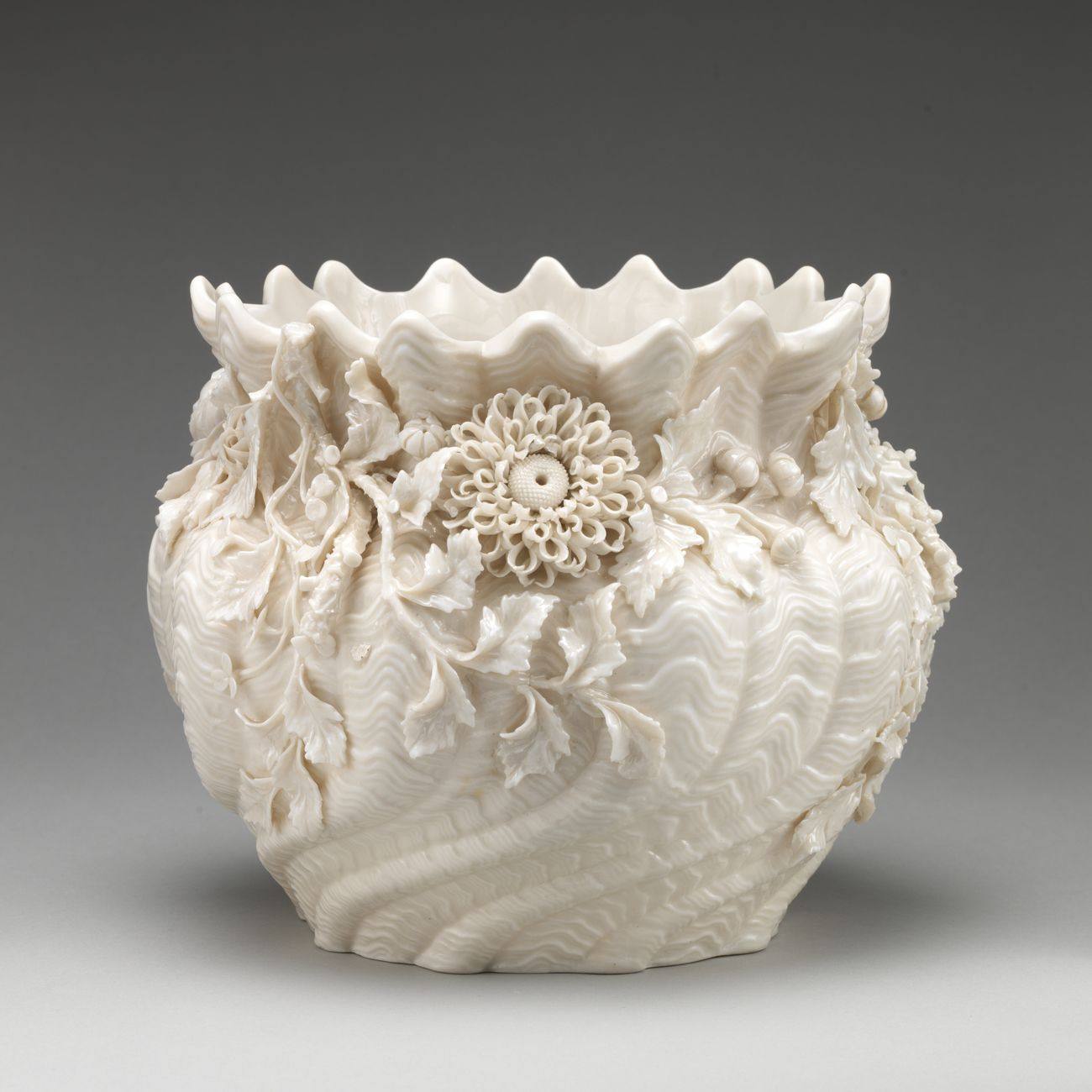
- Where Belleek, Northern Ireland
- Founded Sources differ
- Made Parian porcelain
- Status Still trading
Founded: sources differ, see below. Status: still trading. (Source: Belleek Pottery)
What the sources say
Belleek Pottery's own site says David McBirney & Co was formed in 1857 and the lease on the pottery site signed. (Sources: Belleek Pottery, records 1 and 2)
The V&A says production had started by 1863, possibly as early as 1857, and that porcelain experiments began in 1863 when William Bromley arrived. (Source: the Victoria and Albert Museum)
Jewitt (1878) says the works were established in 1863 by David McBirney and Robert Williams Armstrong, trading as D. McBirney & Co. (Source: Llewellynn Jewitt (1878))
Belleek's own page lists sixteen successive trade marks from 1863 to 2019 and says the first, from 1863 to 1891, was mostly black. (Source: Belleek Pottery)
The marks
9 Belleek Pottery entries
Each entry describes a mark in plain words, with how it was put on and the evidence for its date, in the words of its source.
-
Period stated by the source
Years: 1863 to 1891
Printed trade mark of an Irish wolfhound turned to a round tower, with a harp, shamrock sprigs and a banner reading Belleek; mostly black but sometimes red, blue, orange, green, brown or pink.
- How it was applied
- Printed, in black (mostly)
- Date evidence
- Belleek Pottery gives this mark as: 1st Mark 1863-1891. Open the source
“1st Mark 1863-1891 The colour of the mark during this period was predominantly black but other colours were used, amongst them red, blue, orange, green, brown, and pink.”
-
Period stated by the source
Years: 1863 to 1891
Impressed Belleek, Belleek CO. FERMANAGH, or a small harp or harp and crown (the last more often on earthenware).
- How it was applied
- Pressed into the clay
- Date evidence
- Belleek Pottery gives this mark as: During this period (1st Mark 1863-1891). Open the source
“During this period Belleek also used impressed mark, with the words "Belleek,CO. FERMANAGH" or "Belleek", or a small impressed mark of a harp or harp and crown.”
-
Period stated by the source
Years: 1891 to 1926
Same design with a ribbon round the lower half carrying CO FERMANAGH IRELAND; black.
- How it was applied
- Printed, in black
- Date evidence
- Belleek Pottery gives this mark as: 2nd Mark 1891-1926. Open the source
“The Second mark used from 1891- 1926 reflects the addition of a ribbon surrounding the lower half of the design for the first mark on which appears the words "CO FERMANAGH IRELAND"”
-
Period stated by the source
Years: 1926 to 1946
Black mark with the words REG No 0857 and a round scroll with Celtic decoration reading deanta in eireann (made in Ireland).
- How it was applied
- Printed, in black
- Date evidence
- Belleek Pottery gives this mark as: 3rd Mark 1926-1946. Open the source
“It also contains the registry mark "REG No 0857". Interestingly this registry mark dates from 1884 but was only used from 1926!”
-
Period stated by the source
Years: 1946 to 1955
Mark identical to the third mark except the colour, which changed to green.
- How it was applied
- Printed, in green
- Date evidence
- Belleek Pottery gives this mark as: 4th Mark 1946-1955. Open the source
“The mark is identical to its predecessor in every way except the colour.”
-
Period stated by the source
Years: 1955 to 1965
Green mark with a capital R in a circle added to show United States registration.
- How it was applied
- Printed, in green
- Date evidence
- Belleek Pottery gives this mark as: 5th Mark 1955-1965. Open the source
“A capital "R" in a circle was added in 1955 to signify that the trademark had been registered in the United States.”
-
Period stated by the source
Years: 1965 to 1980
Smaller green mark with the R in a circle moved above the harp.
- How it was applied
- Printed, in green
- Date evidence
- Belleek Pottery gives this mark as: 6th Mark 1965-1980. Open the source
“The "R" in the circle moved to above the harp on the main stamp. The mark is Green.”
-
Period stated by the source
Years: 1980 to 1993
Gold mark, with the round disc reading deanta in eireann left out.
- How it was applied
- Printed, in gold
- Date evidence
- Belleek Pottery gives this mark as: 7th Mark 1980-1993. Open the source
“The colour was changed to gold and the round disk with "deanta in eireann" was omitted.”
-
Seen on a dated museum piece
Years: 1921 to 1954
Impressed BELLEEK, Co. FERMANAGH, IRELAND on a pad (basket).
- How it was applied
- Pressed into the clay
- Date evidence
- Seen on a piece in the Victoria and Albert Museum, dated: ca. 1921-54. Open the source
“'BELLEEK, Co. FERMANAGH, IRELAND'”
Dating clues
- The company says a British Patent Office registration mark gives the date of registration, not the date a piece was made. (Source: Belleek Pottery)
- The company says the 1891 change added the country of origin to the mark in response to the McKinley Tariff Act. (Source: Belleek Pottery)
- The company says the earthenware stamp changed from Belleek to Melvin Ware in 1936. (Source: Belleek Pottery)
Take care
- The REG No 0857 on the 1926-1946 mark is described by the company as a registry number dating from 1884 but only used from 1926, so it is not a date of manufacture. (Source: Belleek Pottery)
- Sources differ on the start: the company says 1857, Jewitt says 1863 for the works, and the V&A says production had started by 1863, possibly 1857. (Source: Llewellynn Jewitt (1878))
Where sources differ
Both sides are shown with their sources. Neither is picked as right.
- Start date of the pottery.
- Established in 1857 (the firm of David McBirney & Co formed and the site lease signed in 1857). (Source: Belleek Pottery)
- The works were established in 1863 by David McBirney and Robert Williams Armstrong. (Source: Llewellynn Jewitt (1878))
- Production had started by 1863, possibly as early as 1857; porcelain experiments began in 1863. (Source: the Victoria and Albert Museum)
- End year of the first black mark.
- The page's list gives 1st Mark 1863-1891. (Source: Belleek Pottery)
- A section heading on the same page reads First Period Black Mark - 1863 - 1890. (Source: Belleek Pottery)
In museum collections
- Dessert stand, ca. 1868. V&A. Photograph not open access, so shown as a link only.
- Cup and saucer with 1891-1926 type mark, ca. 1891-ca. 1926. V&A. Photograph not open access, so shown as a link only.
What could not be confirmed
- The company page describes marks in words only; it does not say where its dates come from, so they rest on the maker's own statement, not on a register.
- No UK or US trade-mark register entry was opened to give filing and first-use dates for the dog, tower and harp mark.
- The page lists marks from 1993 to 2019, which are not recorded here because they are recent.
- The company page contradicts itself once (1863-1890 against 1863-1891 for the first mark).
- Only one public-domain Met object was found; the Met mark text was not opened.
Sources
- V&A Collections record 3886-1901. Victoria and Albert Museum. Opened 22 November 2026.
- V&A Collections record 3891-1901. Victoria and Albert Museum. Opened 22 November 2026.
- V&A Collections record C.51:1,2-2004. Victoria and Albert Museum. Opened 22 November 2026.
- V&A Collections record C.129-1985. Victoria and Albert Museum. Opened 22 November 2026.
- V&A Collections record C.26-1975. Victoria and Albert Museum. Opened 22 November 2026.
- V&A Collections record C.132&A-1912. Victoria and Albert Museum. Opened 22 November 2026.
- Date Your Belleek: Official Marks and Certification. Belleek Pottery. Opened 22 November 2026.
- About Us. Belleek Pottery. Opened 22 November 2026.
- The Ceramic Art of Great Britain, vol. 2, Belleek section, pp. 486-494. Llewellynn Jewitt, London, 1878. Opened 22 November 2026.
- The Met Open Access record 207815, Urn (cachepot), Belleek, ca. 1880. The Metropolitan Museum of Art. Opened 22 November 2026.
Photograph the piece and its mark
Velqo gives a first identification from photos of the piece and its mark.