Minton marks
14 entries from 9 sources. 8 give a period of use stated by a source. The other 6 are marks seen on pieces of known date, which shows only that the mark was in use then.
Go to the marks

- Where Stoke-upon-Trent, England
- Founded Sources differ
- Made Bone china
- Status Not confirmed
Founded: sources differ, see below. Status: not confirmed. (Source: the Metropolitan Museum of Art)
What the sources say
The Met's records give Minton as British, Stoke-on-Trent, 1793 to the present, while Chaffers (1912) says the firm was established in 1790 by Thomas Minton and Burton and Hobson's table says 1796 onwards; the sources disagree. (Sources: the Metropolitan Museum of Art, W. Chaffers, 1912 edition and Burton and Hobson (1919))
Chaffers says the ermine mark has been used on porcelain since 1851, the word MINTON impressed has been the distinctive mark since 1865, and the trade mark was registered in January 1872. (Source: W. Chaffers, 1912 edition)
Chaffers says the firm keeps a private system of year marks, beginning with an eight-rayed star for 1842, a triangle for 1843 and a square for 1844, with numerals in a circle from 1901. (Source: W. Chaffers, 1912 edition)
V&A records of dated pieces show impressed MINTON or MINTONS marks with a year mark or a letter, for example a year mark for 1885 and a year cypher for 1906. (Sources: the Victoria and Albert Museum, records 1 and 2)
The marks
14 Minton entries
Each entry describes a mark in plain words, with how it was put on and the evidence for its date, in the words of its source.
-
Period stated by the source
An early mark of Thomas Minton that Chaffers says has often been confused with an old Sèvres mark with the letter M as the date indicator, on porcelain services painted with flowers and birds.
- How it was applied
- Painted by hand
- Date evidence
- W. Chaffers, 1912 edition gives this mark as: Chaffers gives no date. Open the source
“The annexed is an early mark of Thomas Minton of Stoke, and has been frequently confounded with that of old Sevres, with the letter M as the date indicator.”
-
Period stated by the source
Years: 1836 to 1842
The names Minton and Boyle, as a partnership mark.
- How it was applied
- Pressed into the clay
- Date evidence
- Burton and Hobson (1919) gives this mark as: from 1836 to about 1842. Open the source
“Minton and Boyle 1836-42 imp.”
-
Period stated by the source
Years: 1845 to 1861
The stamp B. B. New Stone (B. B. meaning Best Body) on earthenware.
- How it was applied
- Pressed into the clay
- Date evidence
- W. Chaffers, 1912 edition gives this mark as: From 1845 to 1861 all earthenware made by Minton was stamped B. B. New Stone. Open the source
“From 1845 to 1861 all earthenware made by Minton was stamped “ B. B. New Stone.””
-
Period stated by the source
Years: 1842 to 1900
Private year marks, beginning with an eight-rayed star for 1842, a triangle for 1843, a square for 1844 and a trefoil in 1850, then other signs and symbols.
- How it was applied
- Pressed into the clay
- Date evidence
- W. Chaffers, 1912 edition gives this mark as: commencing with an eight-rayed star for 1842 ... other signs and symbols until 1 900. Open the source
“the firm have a system of “year marks” commencing with an eight-rayed star for 1842, a triangle for 1843, a square for 1844, the trefoil in 1850, and other signs and symbols until 1 900”
-
Period stated by the source
Years: from 1901
The numerals 1, 2 and so on inside a circle, for the years 1901 onwards.
- How it was applied
- Pressed into the clay
- Date evidence
- W. Chaffers, 1912 edition gives this mark as: after which the numerals 1, 2, etsequitur, inside a circle, denote the years 1901. Open the source
“after which the numerals 1, 2, etsequitur, inside a circle, denote the years 1901, &c., &c.”
-
Period stated by the source
Years: from 1851
An ermine mark, indented or painted in gold and colours, on porcelain.
- How it was applied
- Painted by hand, in gold and colours
- Date evidence
- W. Chaffers, 1912 edition gives this mark as: has since 1851 been used on porcelain. Open the source
“The ermine mark, indented or painted in gold and colours, has since 1851 been used on porcelain.”
-
Period stated by the source
Years: from 1865
The word MINTON impressed in the clay, on china and earthenware.
- How it was applied
- Pressed into the clay
- Date evidence
- W. Chaffers, 1912 edition gives this mark as: has been the distinctive mark since 1865. Open the source
“The word minton impressed has been the distinctive mark since 1865, both for china and … earthenware.”
-
Period stated by the source
Years: from 1872
The trade mark MINTON, registered in January 1872; Chaffers says all works after that date are so stamped.
- How it was applied
- Pressed into the clay
- Date evidence
- W. Chaffers, 1912 edition gives this mark as: In January 1872 this trade-mark was registered. Open the source
“In January 1872 this trade-mark … was registered, and all their works subsequent to that date are so stamped.”
-
Seen on a dated museum piece
Years: 1856
A maker's date code and a diamond registration mark on a lettuce jug.
- How it was applied
- Method not stated by the source
- Date evidence
- Seen on a piece in the Victoria and Albert Museum, dated: V&A object date 1856. Open the source
“Maker's date code for 1856”
-
Seen on a dated museum piece
Years: 1862
The impressed word Minton with a year mark for 1862.
- How it was applied
- Pressed into the clay
- Date evidence
- Seen on a piece in the Victoria and Albert Museum, dated: V&A object date 1862. Open the source
“Minton … year mark for 1862”
-
Seen on a dated museum piece
Years: 1875
The word MINTONS impressed, with the letters Y and V on a plate.
- How it was applied
- Pressed into the clay
- Date evidence
- Seen on a piece in the Victoria and Albert Museum, dated: V&A object date 1875. Open the source
“'MINTONS' (method: impressed)”
-
Seen on a dated museum piece
Years: 1876
The word MINTON impressed with the letter F and a circle inside a triangle, on a plate.
- How it was applied
- Pressed into the clay
- Date evidence
- Seen on a piece in the Victoria and Albert Museum, dated: V&A object date 1876. Open the source
“MINTON' impressed on reverse, maker's mark”
-
Seen on a dated museum piece
Years: 1885
The word Mintons with a year mark for 1885 and the letter E, all impressed.
- How it was applied
- Pressed into the clay
- Date evidence
- Seen on a piece in the Victoria and Albert Museum, dated: V&A object date 1885. Open the source
“Mark: 'Mintons', year mark for 1885, 'E' and an unidentified mark, all impressed”
-
Seen on a dated museum piece
Years: 1906
The word Mintons with a year cypher for 1906 and Minton Co. Ltd / No. 8.
- How it was applied
- Pressed into the clay
- Date evidence
- Seen on a piece in the Victoria and Albert Museum, dated: V&A object date 1906. Open the source
“Mintons … year cypher for 1906”
Dating clues
- Chaffers says the year marks are private and not published by the firm, though some customers have a list to verify their pieces. (Source: W. Chaffers, 1912 edition)
- V&A catalogue records read impressed symbols on dated Minton pieces as year marks (1856, 1862, 1885, 1906), so a symbol can point to a year, but no published key is available to read one. (Source: the Victoria and Albert Museum)
Take care
- Chaffers says the Dresden crossed swords were occasionally used by Minton as a mark, with the word Minton in red. (Source: W. Chaffers, 1912 edition)
- Chaffers says a mark first attributed to Barr of Worcester was wrongly attributed and is the Minton B. B. New Stone mark. (Source: W. Chaffers, 1912 edition)
- Chaffers records that Minton, Hollins and Co. (tiles) was a separate firm founded when Michael Daintry Hollins left Colin Minton Campbell's partnership in 1868. (Source: W. Chaffers, 1912 edition)
Where sources differ
Both sides are shown with their sources. Neither is picked as right.
- When the Minton works began.
- Minton's, established in 1790 by Thomas Minton. (Source: W. Chaffers, 1912 edition)
- Minton 1796 onwards (porcelain table). (Source: Burton and Hobson (1919))
- Minton(s), British, Stoke-on-Trent, 1793-present. (Source: the Metropolitan Museum of Art)
In museum collections
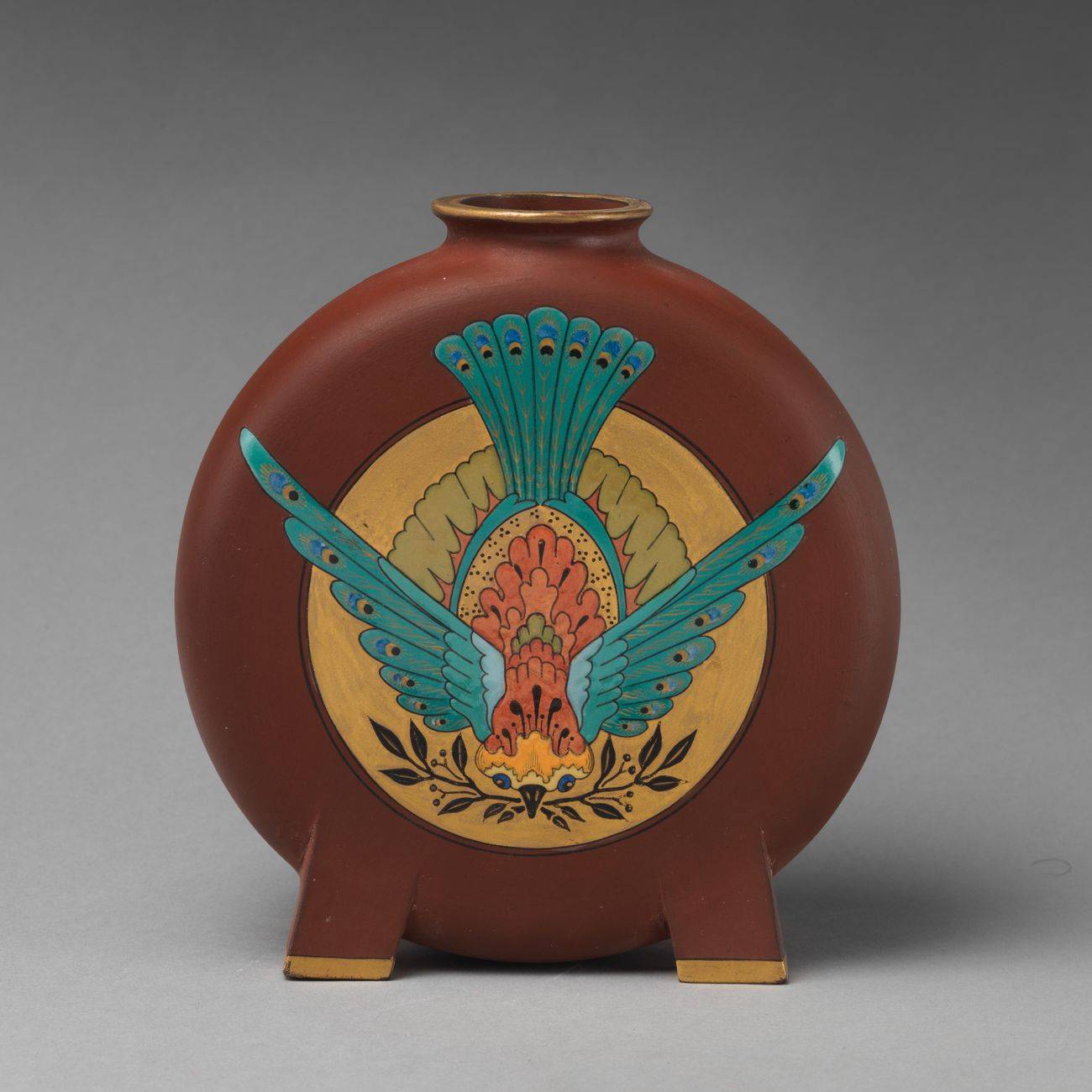
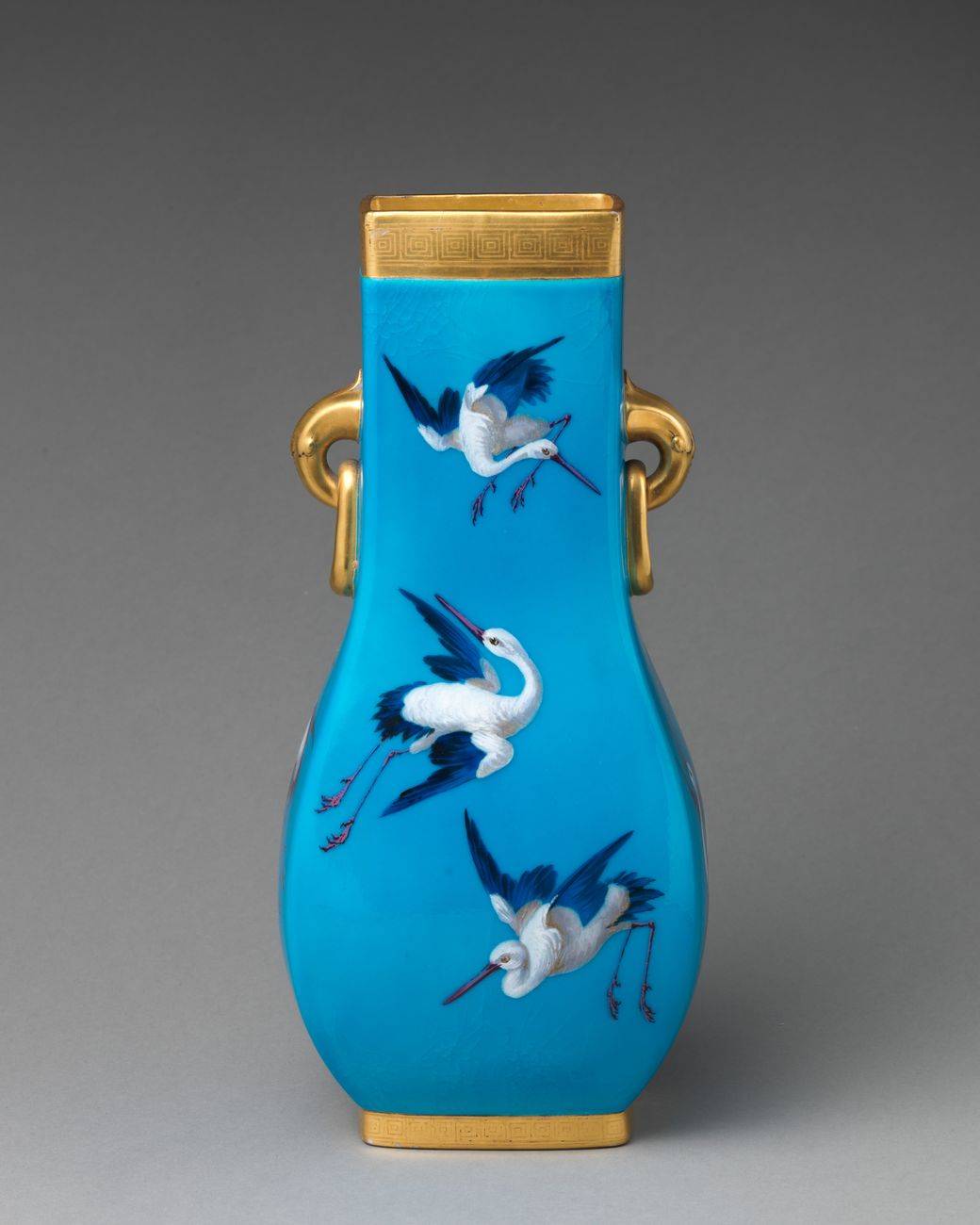
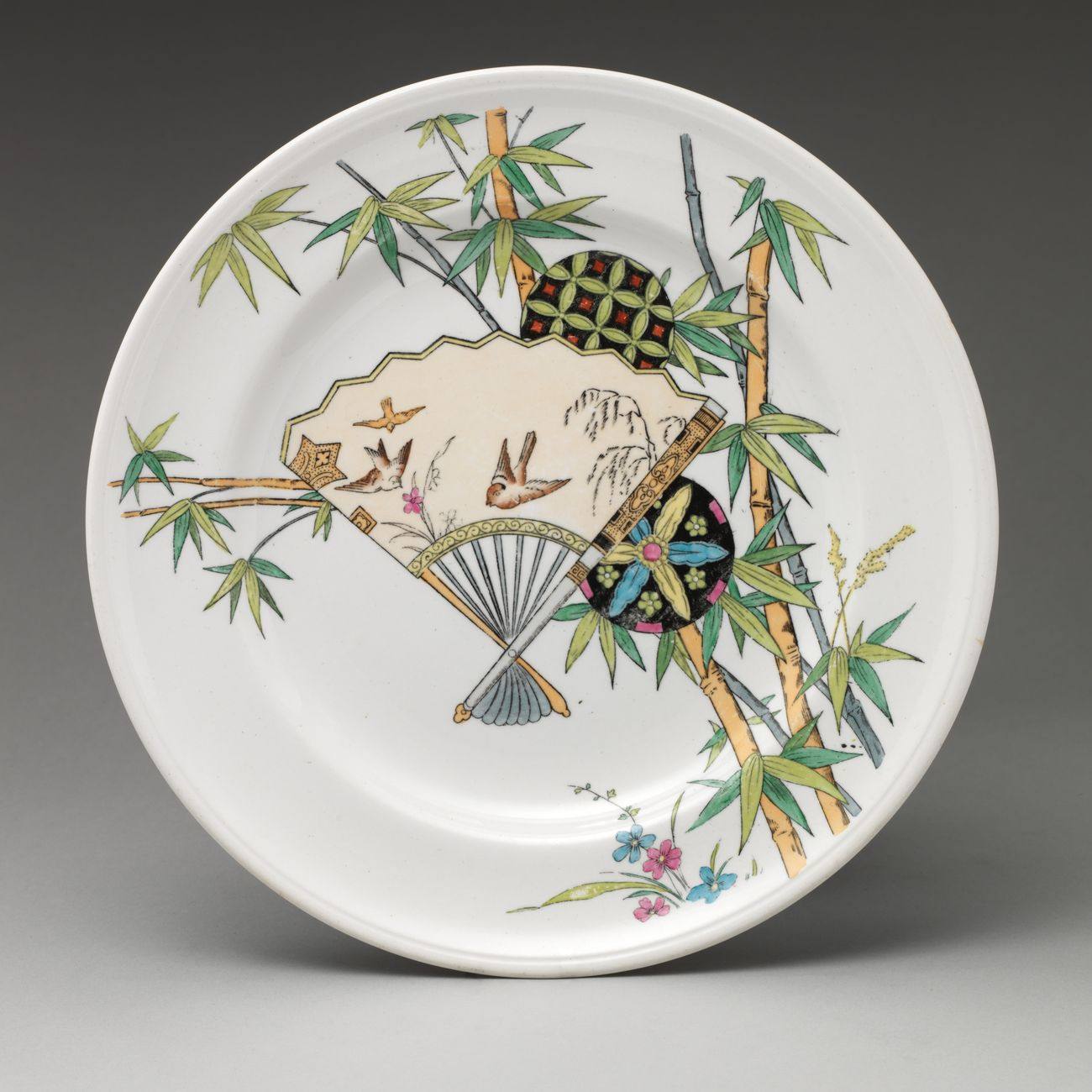
- Plate, 1880. Cleveland Museum of Art.
- Plate made for Emperor Meiji, c. 1875. Cleveland Museum of Art.
What could not be confirmed
- The sources give three different start dates (1790, 1793 and 1796), so the founding year is shown as differing.
- Chaffers says the firm's year-mark key was private, and no published key from the firm or its successor was found, so a year cannot be read from a symbol alone.
- The Met records used here give the maker and date of each object but no mark text.
- Burton and Hobson print 'since 1861 imp.' beside the Minton entries, but the scan does not show which mark it refers to; Chaffers gives 1865 for the impressed word MINTON.
- No source used here gives the marks used after 1912.
Sources
- Handbook of Marks on Pottery and Porcelain (Burton and Hobson). Macmillan (scan of the archive.org copy listed as 1919; first edition 1909), 1919. Opened 22 November 2026.
- Marks and Monograms on European and Oriental Pottery and Porcelain (W. Chaffers, 1912 edition). Reeves and Turner, London, 1912. Opened 22 November 2026.
- Moon flask with Aesthetic bird motif, Minton(s), 1867 (accession 2018.62.11), maker biography field. The Metropolitan Museum of Art. Opened 22 November 2026.
- Plate, Minton, 1876 (museum no. O1273510). Victoria and Albert Museum. Opened 22 November 2026.
- Secession ware, Minton, 1906 (museum no. O150877). Victoria and Albert Museum. Opened 22 November 2026.
- Lettuce jug, Minton, 1856 (museum no. O151060). Victoria and Albert Museum. Opened 22 November 2026.
- Henry II ware, Minton, 1862 (museum no. O151116). Victoria and Albert Museum. Opened 22 November 2026.
- Comport, Minton, 1885 (museum no. O77917). Victoria and Albert Museum. Opened 22 November 2026.
- Plate, Minton, 1875 (museum no. O80298). Victoria and Albert Museum. Opened 22 November 2026.
Photograph the piece and its mark
Velqo gives a first identification from photos of the piece and its mark.