Royal Crown Derby marks
17 entries from 7 sources. 15 give a period of use stated by a source. The other 2 are marks seen on pieces of known date, which shows only that the mark was in use then.
Go to the marks

- Where Derby, England
- Founded Sources differ
- Made Soft-paste porcelain
- Status Still trading
Founded: sources differ, see below. Status: still trading. (Source: the Royal Crown Derby Porcelain Company Limited)
What the sources say
Royal Crown Derby's own history says Andrew Planche established the first china works in Derby in 1750 and that King George III granted the crown in the backstamp in 1775; Chaffers (1912) says William Duesbury started the Derby works in 1756 and that the crown mark was used from about 1780. (Sources: the Royal Crown Derby Porcelain Company Limited and W. Chaffers, 1912 edition)
Chaffers says the Chelsea works were united to Derby in 1769 (his chronology gives 1770 for the purchase); Burton and Hobson date the Chelsea-Derby mark 1770-84 and the maker lists it at Chelsea about 1770 to 1783. (Sources: W. Chaffers, 1912 edition, Burton and Hobson (1919) and the Royal Crown Derby Porcelain Company Limited)
The maker divides its marks into the Nottingham Road factory (1761 to 1848), the King Street factory (1848 to 1935) and the Osmaston Road factory (1877 to 2000), the last of which began as the Derby Crown Porcelain Company and was granted Royal in 1890. (Sources: the Royal Crown Derby Porcelain Company Limited, records 1 and 2 and W. Chaffers, 1912 edition)
The maker says Royal Crown Derby carries a year mark, with roman numerals from 1938; its page shows year symbols from 1880 to 1937 as pictures. (Source: the Royal Crown Derby Porcelain Company Limited)
The marks
17 Royal Crown Derby entries
Each entry describes a mark in plain words, with how it was put on and the evidence for its date, in the words of its source.
-
Period stated by the source
Years: until 1769
A plain D or the word Derby, usually roughly scratched in the paste, on Duesbury's earliest work.
- How it was applied
- Scratched into the clay
- Date evidence
- W. Chaffers, 1912 edition gives this mark as: The early mark used before 1769. Open the source
“The early mark used before 1769 was either a simple D or the word Derby”
-
Period stated by the source
Years: 1769 to 1784
The Chelsea anchor crossing an italic capital D, marking the union of the Chelsea and Derby works.
- How it was applied
- Painted by hand
- Date evidence
- W. Chaffers, 1912 edition gives this mark as: The Chelsea Works were united to those of Derby in 1769; the maker lists the mark in use at Derby c. 1775 and at Chelsea c. 1770 to 1783. Open the source
“this union is denoted by the anchor of Chelsea crossing an italic capital D.”
-
Period stated by the source
Years: from 1775
The Chelsea Derby mark as it was used at Derby, usually in blue and occasionally in puce.
- How it was applied
- Painted by hand, in blue, occasionally puce
- Date evidence
- The Royal Crown Derby Porcelain Company Limited gives this mark as: c. 1775 Chelsea Derby in use at Derby. Open the source
“c. 1775 Chelsea Derby in use at Derby; usually in blue, occasionally in puce.”
-
Period stated by the source
Years: 1780 to 1830
A crown above a cross (crossed batons) with three dots in each side angle and a capital D below.
- How it was applied
- Painted by hand, in usually red, occasionally blue or violet (Chaffers, same passage)
- Date evidence
- W. Chaffers, 1912 edition gives this mark as: used from about 1780 by the Duesburys, and continued by Mr. Robert Bloor as late as 1830. Open the source
“a crown above a cross, and three dots in each side angle, below which is a capital D, used from about 1780 by the Duesburys, and continued by Mr. Robert Bloor as late as 1830”
-
Period stated by the source
Years: from 1782
The Crown Derby mark painted in colours: early marks in blue, puce or gold, later in red.
- How it was applied
- Painted by hand, in blue, puce or gold; later red
- Date evidence
- Burton and Hobson (1919) gives this mark as: c. 1782 onwards. Open the source
“Crown Derby mark painted in colours c. 1782 onwards. Early marks in blue, puce, or gold, later in red”
-
Period stated by the source
Years: from 1775
The crown in the Derby backstamp, which the maker says King George III allowed in 1775.
- How it was applied
- Painted by hand
- Date evidence
- The Royal Crown Derby Porcelain Company Limited gives this mark as: in 1775, he granted the honour of incorporating the crown into the brand's iconic backstamp. Open the source
“in 1775, he granted the honour of incorporating the crown into the brand’s iconic backstamp.”
-
Period stated by the source
Years: 1784 to 1825
The Derby back stamp (crown, crossed batons, dots and D), precise at first and increasingly carelessly drawn after 1820; blue and puce to 1806, then red.
- How it was applied
- Painted by hand, in blue and puce to 1806, then red
- Date evidence
- The Royal Crown Derby Porcelain Company Limited gives this mark as: c. 1784 – 1825. Open the source
“c. 1784 – 1825 After 1820 the previously precise back stamp became increasingly carelessly drawn. Blue and Puce were used until 1806, after which red became the standard colour.”
-
Seen on a dated museum piece
Years: 1784 to 1785
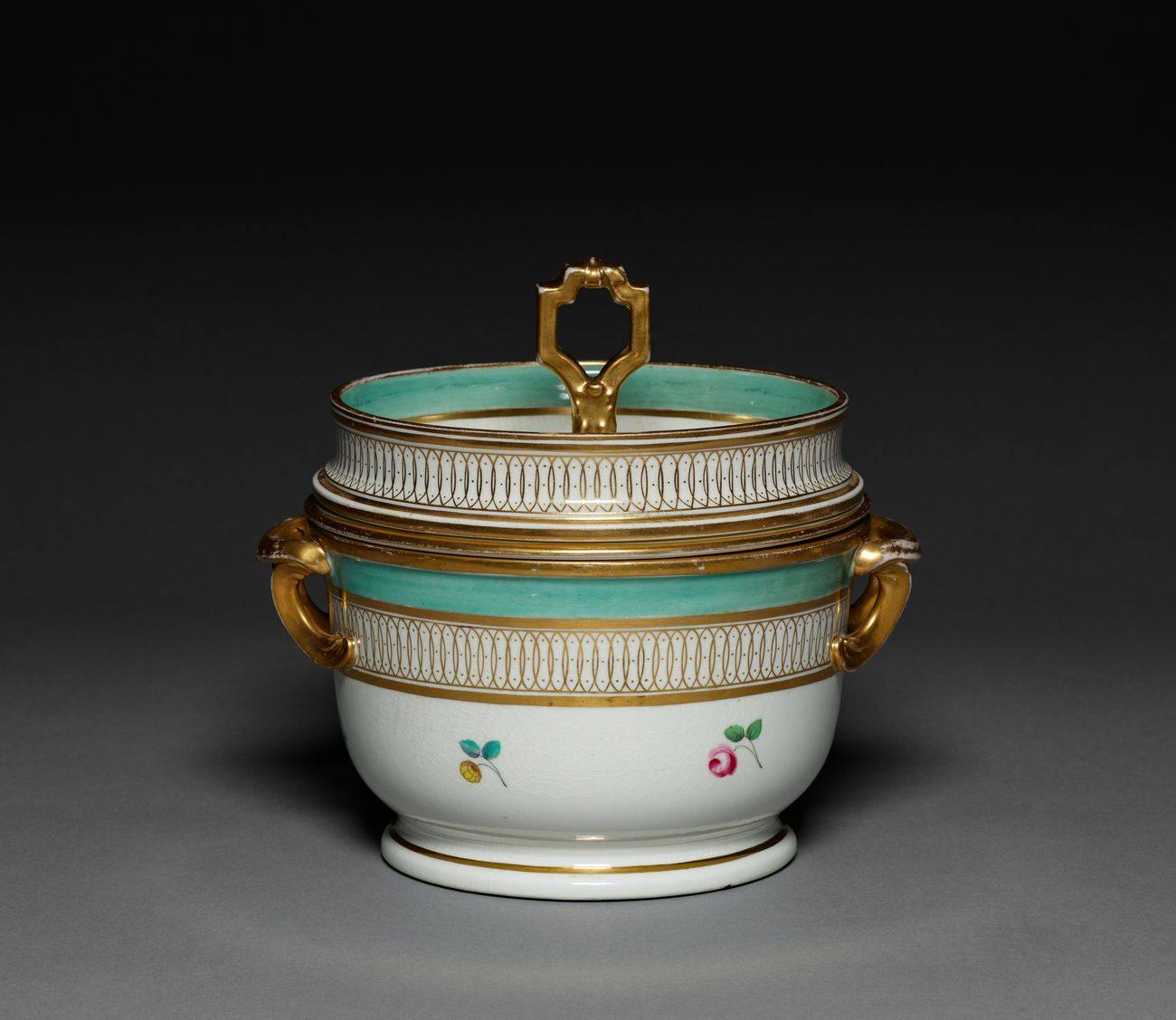
Crown over D with crossed batons and six dots, painted in puce, on a pair of ice pails.
- How it was applied
- Painted by hand, in puce
- Date evidence
- Seen on a piece in the Victoria and Albert Museum, dated: V&A: probably 1784-5. Open the source
“Crown over D with crossed batons and six dots”
-
Seen on a dated museum piece
Years: 1800
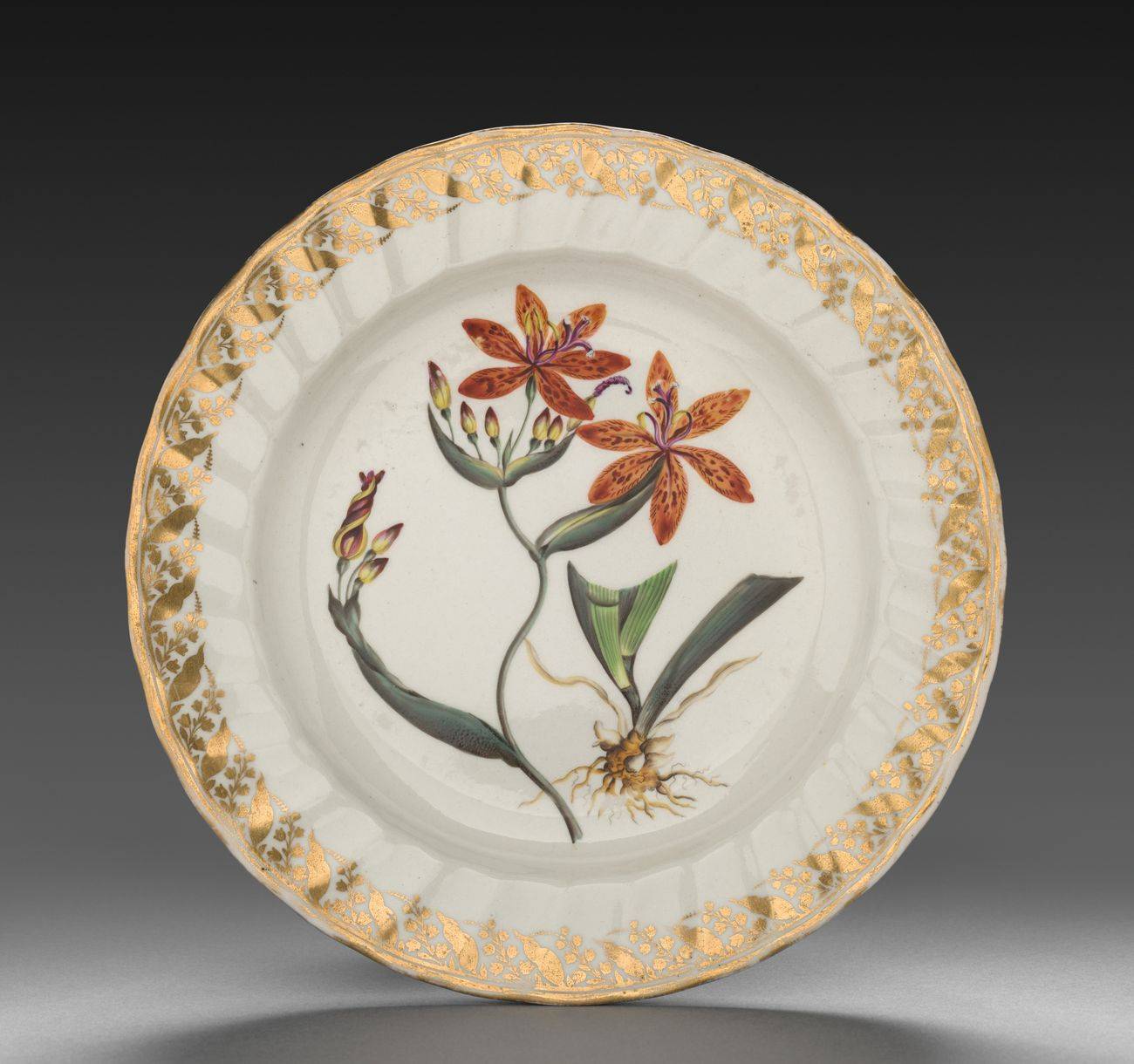
A crown, crossed batons and dots, the letter D and the number 115 inscribed in blue on the back of a dessert plate.
- How it was applied
- Painted by hand, in blue
- Date evidence
- Seen on a piece in the Cleveland Museum of Art, dated: Cleveland object date c. 1800. Open the source
“inscribed in blue on back: Ixia Chinensis./Chinese Ixia./crown/crossed batons and dots/D/115.”
-
Period stated by the source
Years: 1795 to 1797
The monogram of Duesbury and Kean (D K) with the crown, in purple.
- How it was applied
- Painted by hand, in purple, in colour
- Date evidence
- Burton and Hobson (1919) gives this mark as: Monogram of Duesbury and Kean, 1795-7. Open the source
“Monogram of … Duesbury and … Kean, 1795-7”
-
Period stated by the source
Years: from 1795
The mark of Messrs. Duesbury and Kean, a Crown Derby mark in purple with D K.
- How it was applied
- Painted by hand, in purple
- Date evidence
- W. Chaffers, 1912 edition gives this mark as: used occasionally after 1795. Open the source
“The mark of Messrs. Duesbury & Kean, used occasionally after 1795”
-
Period stated by the source
Years: from 1830
The name BLOOR and DERBY, printed rather than painted, with a crown.
- How it was applied
- Printed
- Date evidence
- W. Chaffers, 1912 edition gives this mark as: continued using the marks adopted by them ... until 1830, when he discontinued it, and substituted his own name. Open the source
“continued using the marks adopted by them of the crown, crossed daggers, and dots, with the letter D, until 1830, when he discontinued it, and substituted his own name.”
-
Period stated by the source
Years: 1891 to 1921
The Royal Crown Derby mark, with the word England in a vertical position at the right.
- How it was applied
- Printed
- Date evidence
- The Royal Crown Derby Porcelain Company Limited gives this mark as: c. 1891 – 1921 Royal Crown Derby The word England in a vertical position to the right hand side. Open the source
“c. 1891 – 1921 Royal Crown Derby The word England in a vertical position to the right hand side.”
-
Period stated by the source
Years: 1921 to 1964
The Royal Crown Derby mark with Made in England horizontally beneath the stamp.
- How it was applied
- Printed
- Date evidence
- The Royal Crown Derby Porcelain Company Limited gives this mark as: c. 1921 – 1964 Made in England horizontally beneath the stamp. Open the source
“c. 1921 – 1964 Made in England horizontally beneath the stamp.”
-
Period stated by the source
Years: 1940 to 1945
A wartime mark in dark green, usually without the year code, also used on undecorated utility wares.
- How it was applied
- Printed, in dark green
- Date evidence
- The Royal Crown Derby Porcelain Company Limited gives this mark as: c. 1940 – 1945. Open the source
“c. 1940 – 1945 Wartime mark in dark green Usually without the year code (also used on undecorated utility wares)”
-
Period stated by the source
Years: 1880 to 1937
A year identification symbol printed with the mark, one for each year from 1880 to 1937 (shown as pictures on the maker's page).
- How it was applied
- Printed
- Date evidence
- The Royal Crown Derby Porcelain Company Limited gives this mark as: YEAR IDENTIFICATION MARKS 1880 -1937. Open the source
“YEAR IDENTIFICATION MARKS 1880 -1937”
-
Period stated by the source
Years: from 1938
Roman numerals as the year mark; X and V were each used twice, so 1902 and 1905 carry the word England and 1942 and 1947 carry Made in England.
- How it was applied
- Printed
- Date evidence
- The Royal Crown Derby Porcelain Company Limited gives this mark as: From 1938, roman numerals have been used – the only exception being the 2000. Open the source
“From 1938, roman numerals have been used – the only exception being the 2000, which had a special mark of two interlaced ‘M’s. ‘X’ and ‘V’ have been used twice as date marks – to avoid confusion, 1902 & 1905 are accompanied by ‘England’, while the roman numerals used for 1942 & 1947 are accompanied by ‘Made in England’”
Dating clues
- The maker says Royal Crown Derby carries a date mark that identifies the year of manufacture. (Source: the Royal Crown Derby Porcelain Company Limited)
- Chaffers says all Derby marks before 1830 were painted by brush and later ones were printed. (Source: W. Chaffers, 1912 edition)
- The maker says the Osmaston Road trade marks run 1877 to 2000, with Royal and England added from about 1891, and Chaffers says Royal was granted in 1890 with an altered trade mark. (Source: W. Chaffers, 1912 edition)
Take care
- The V&A says a Paris firm (Samson) made copies of Crown Derby figures with a copied Crown Derby mark; the mark on that figure is described as a copy of one used about 1800 to 1825. (Source: the Victoria and Albert Museum)
- The V&A says Samson claimed to mark pieces with his own double S mark as well as the mark of the original, but in many cases his own mark is missing. (Source: the Victoria and Albert Museum)
- The maker says a pseudo-Meissen mark is occasionally seen on late Bloor and a pseudo-Sèvres mark was used on Sèvres copies from about 1830 to 1848. (Source: the Royal Crown Derby Porcelain Company Limited)
- Chaffers says Sampson Hancock's business in King Street, Derby, has no connection with the Royal Crown Derby Porcelain Company, and the maker says the Old Crown Derby China Works at King Street was set up by workers after the Nottingham Road factory closed. (Source: W. Chaffers, 1912 edition)
- The maker lists separate King Street artist marks from 1848 to 1935 (Locker and Co, Stephenson Sharp and Co, Stevenson and Hancock, Sampson Hancock, Larcombe and Paget, Paget) that are not Royal Crown Derby marks. (Source: the Royal Crown Derby Porcelain Company Limited)
Where sources differ
Both sides are shown with their sources. Neither is picked as right.
- When china making began at Derby.
- Andrew Planche established the first china works in Derby in 1750. (Source: the Royal Crown Derby Porcelain Company Limited)
- William Duesbury started the Derby works in 1756. (Source: W. Chaffers, 1912 edition)
- When the crown was added to the Derby mark.
- King George III granted the crown for the backstamp in 1775. (Source: the Royal Crown Derby Porcelain Company Limited)
- The crown, cross, dots and D mark used from about 1780. (Source: W. Chaffers, 1912 edition)
- Crown Derby mark c. 1782 onwards. (Source: Burton and Hobson (1919))
- The Derby back stamp listed as c. 1784 to 1825. (Source: the Royal Crown Derby Porcelain Company Limited)
- When the Osmaston Road works began.
- Phillips and Litherland opened the Osmaston Works in 1875. (Source: the Royal Crown Derby Porcelain Company Limited)
- Osmaston Road trade marks from c. 1877. (Source: the Royal Crown Derby Porcelain Company Limited)
- Start of the Bloor period.
- Robert Bloor bought the works in 1811 (chronology), but the text says he succeeded Duesbury and Kean about 1815. (Source: W. Chaffers, 1912 edition)
- Bloor period 1811-44. (Source: Burton and Hobson (1919))
- Robert Bloor's printed gothic marks c. 1825 to 1848. (Source: the Royal Crown Derby Porcelain Company Limited)
In museum collections
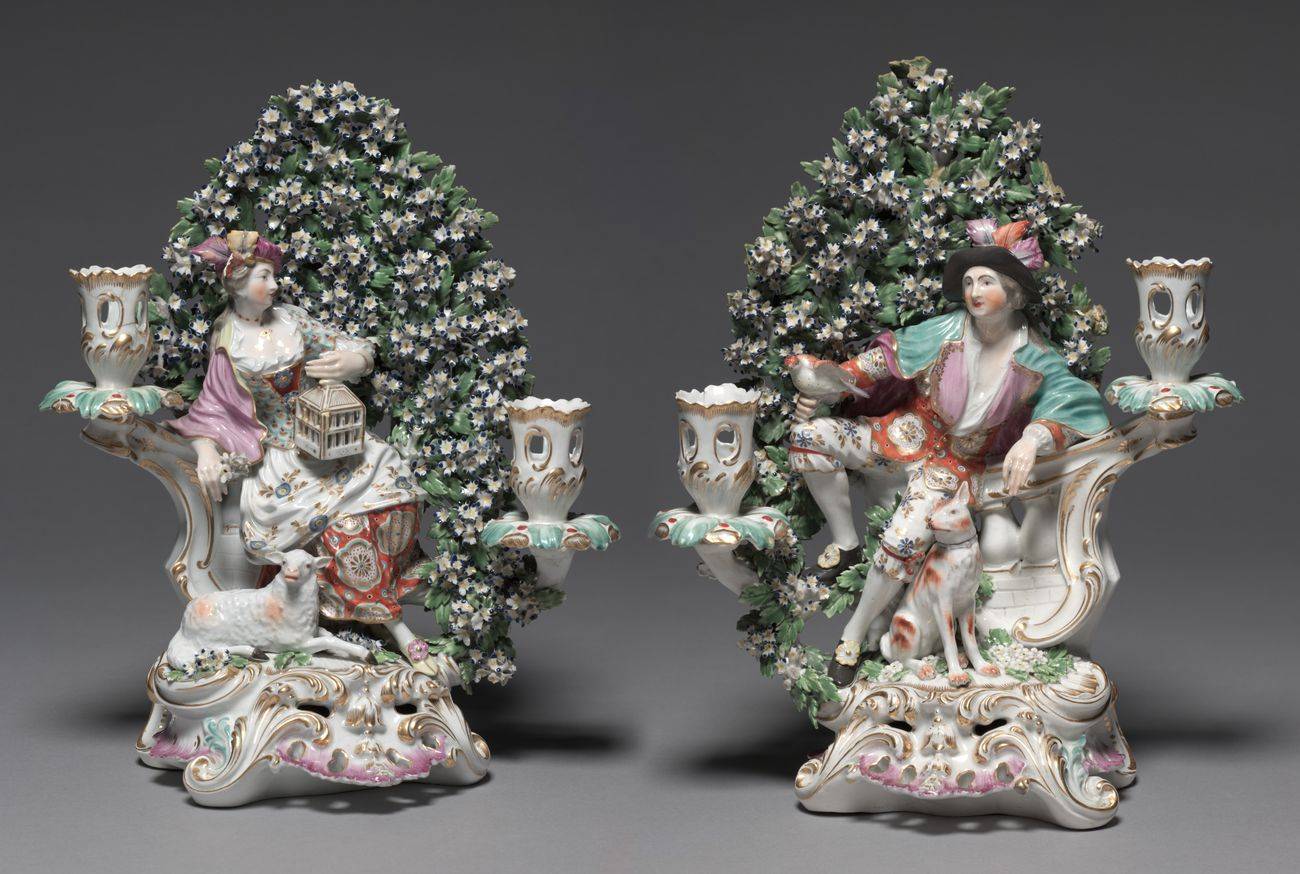
- Flower Pot and Flowers, 1811–1848. Cleveland Museum of Art.
- Dessert Service, c. 1800. Cleveland Museum of Art.
What could not be confirmed
- The sources give different years for the start of china making at Derby, the first crown mark and the Osmaston Road works, so these are shown as differing.
- The maker shows its year symbols for 1880 to 1937 only as pictures, so no list of symbols and years is given; only the roman numeral rule from 1938 is in its text.
- Marks used after 1952 (the maker lists stamps for 1952 to 1975 and 1976 to 2013/4) are not described.
- There are no photographs of the marks.
Sources
- Handbook of Marks on Pottery and Porcelain (Burton and Hobson). Macmillan (scan of the archive.org copy listed as 1919; first edition 1909), 1919. Opened 22 November 2026.
- Marks and Monograms on European and Oriental Pottery and Porcelain (W. Chaffers, 1912 edition). Reeves and Turner, London, 1912. Opened 22 November 2026.
- Plate from Dessert Service: Chinese Ixia, c. 1800 (accession 1989.189.15). Cleveland Museum of Art (Open Access, CC0). Opened 22 November 2026.
- Historic Backstamps (Royal Crown Derby). The Royal Crown Derby Porcelain Company Limited. Opened 22 November 2026.
- Our Heritage (Royal Crown Derby). The Royal Crown Derby Porcelain Company Limited. Opened 22 November 2026.
- Figurine of Othello, Samson copy of a Crown Derby figure, late 19th century (museum no. O121334). Victoria and Albert Museum. Opened 22 November 2026.
- Ice pail, Derby, probably 1784-5 (museum no. O1295320). Victoria and Albert Museum. Opened 22 November 2026.
Photograph the piece and its mark
Velqo gives a first identification from photos of the piece and its mark.