Meissen marks
11 entries from 7 sources. 9 give a period of use stated by a source. The other 2 are marks seen on pieces of known date, which shows only that the mark was in use then.
Go to the marks

- Where Meissen, Germany
- Founded 1710
- Made Hard-paste porcelain
- Status Still trading
Founded 1710: (Source: Staatliche Porzellan-Manufaktur Meissen GmbH). Status: still trading. (Source: Staatliche Porzellan-Manufaktur Meissen GmbH)
What the sources say
Meissen's own history page says the first European porcelain manufactory was founded at Meissen in 1710 by Augustus the Strong, with Böttger in charge. (Source: Staatliche Porzellan-Manufaktur Meissen GmbH)
The same page says the factory's inspector, Johann Melchior Steinbrück, suggested in 1722 that the crossed swords of the Saxon electoral arms be used to mark original Meissen porcelain. (Source: Staatliche Porzellan-Manufaktur Meissen GmbH)
The German Patent and Trade Mark Office says the swords were generally established from 1731 and that the manufactory registered its trade marks on 20 May 1875. (Source: Deutsches Patent- und Markenamt)
A V&A record shows that a blue M. P. M. mark was used on teapots and sugar boxes in services in spring to November 1722, so the swords were not the only Meissen mark in the 1720s. (Sources: the Victoria and Albert Museum and Deutsches Patent- und Markenamt)
Books of 1912 and 1919 and the maker's own page agree that dots and stars were added to the swords in the later eighteenth century, but give different dates for them. (Sources: W. Chaffers, 1912 edition, Burton and Hobson (1919) and Staatliche Porzellan-Manufaktur Meissen GmbH)
The marks
11 Meissen entries
Each entry describes a mark in plain words, with how it was put on and the evidence for its date, in the words of its source.
-
Period stated by the source
Years: 1722
The three letters M. P. M. painted in blue (for Meissener Porzellan Manufaktur), without swords.
- How it was applied
- Painted by hand, in blue
- Date evidence
- The Victoria and Albert Museum gives this mark as: used on teapots and sugar boxes in services Spring-November 1722. Open the source
“M. P. M. In blue (for Meissener Porzellan Manufaktur, used on teapots and sugar boxes in services Spring-November 1722)”
-
Period stated by the source
Years: 1710 to 1712
The linked letters A R (Augustus Rex) in a monogram, with no swords.
- How it was applied
- Painted by hand, in blue
- Date evidence
- W. Chaffers, 1912 edition gives this mark as: was in use from about 1710-12. Open the source
“The first mark used was the monogram A.R. (Augustus Rex), and was affixed to all pieces intended for royal use.”
-
Seen on a dated museum piece
Years: 1734
The linked letters A R in a monogram, painted in blue, on a vase and cover that the V&A dates to about 1734.
- How it was applied
- Painted by hand, in blue
- Date evidence
- Seen on a piece in the Victoria and Albert Museum, dated: ca. 1734. Open the source
“'AR' [in monogram] In blue”
-
Period stated by the source
Years: from 1722
Two crossed swords with the blades crossing in an X, painted by hand in cobalt blue under the glaze, taken from the Saxon coat of arms.
- How it was applied
- Painted by hand, in underglaze cobalt blue
- Date evidence
- Staatliche Porzellan-Manufaktur Meissen GmbH gives this mark as: After the Saxon electoral swords were introduced in 1722. Open the source
“After the Saxon electoral swords were introduced in 1722”
-
Period stated by the source
Years: from 1731
The same crossed swords, described by the German trade mark office as the established mark of the manufactory.
- How it was applied
- Painted by hand, in underglaze blue
- Date evidence
- Deutsches Patent- und Markenamt gives this mark as: From 1731 onwards, the "crossed swords" had become generally established. Open the source
“From 1731 onwards, the "crossed swords" had become generally established.”
-
Period stated by the source
Years: from 1725
Crossed swords from the arms of Saxony, painted in blue, rarely in gold, purple or red (Burton and Hobson's table of Meissen marks).
- How it was applied
- Painted by hand, in blue (rarely gold, purple or red)
- Date evidence
- Burton and Hobson (1919) gives this mark as: used from 1725 onwards. Open the source
“The cross swords from the Arms of Saxony used … from 1725 … onwards.”
-
Seen on a dated museum piece
Years: 1760 to 1762
Two crossed swords painted in blue on the underside of the base of a Meissen figure.
- How it was applied
- Painted by hand, in blue
- Date evidence
- Seen on a piece in the Victoria and Albert Museum, dated: ca. 1760-62. Open the source
“two crossed swords, painted in blue on the bottom of the base”
-
Period stated by the source
Years: 1763 to 1774
Crossed swords with a small dot between the hilts.
- How it was applied
- Painted by hand, in blue
- Date evidence
- W. Chaffers, 1912 edition gives this mark as: commenced in 1763 when a slight variation of the mark was adopted by placing a dot between the hilts; the next change is dated 1774. Open the source
“Another period may be said to have commenced in 1763 when a slight variation of the mark was adopted by placing a dot between the hilts of the swords”
-
Period stated by the source
Years: 1765 to 1774
Crossed swords with a dot (the maker calls this the Dot Sword Mark).
- How it was applied
- Painted by hand, in blue
- Date evidence
- Staatliche Porzellan-Manufaktur Meissen GmbH gives this mark as: from 1765 to 1774 with the so-called "Dot Sword Mark". Open the source
“the porcelains were marked as originals from 1765 to 1774 with the so-called "Dot Sword Mark"”
-
Period stated by the source
Years: 1774 to 1814
Crossed swords with a small star between the sword hilts.
- How it was applied
- Painted by hand, in blue
- Date evidence
- W. Chaffers, 1912 edition gives this mark as: from 1774- 1814, by a star between the sword hilts. Open the source
“that of the Marcolini period, from 1774- 1814, by a star between the sword hilts”
-
Period stated by the source
Years: 1774 to 1814
Crossed swords with a star added below them (the maker calls it the Marcolini star).
- How it was applied
- Painted by hand, in underglaze blue
- Date evidence
- Staatliche Porzellan-Manufaktur Meissen GmbH gives this mark as: From 1774 onwards, a "Marcolini star" was added to the trademark below the swords. Open the source
“From 1774 onwards, a "Marcolini star" was added to the trademark below the swords.”
Dating clues
- From 1948 onwards each piece also has a year sign stamped into the base, according to the German trade mark office. (Source: Deutsches Patent- und Markenamt)
- Chaffers (1912) says an incised reference number, in addition to the swords, marks a specimen as modern in his sense of the word. (Source: W. Chaffers, 1912 edition)
- The dates given for the dot and star variants differ between sources: the maker says dot 1765 to 1774 and star from 1774; Chaffers says dot from 1763 and star 1774 to 1814. Treat a dot or star as a clue to the later eighteenth century, not as a year. (Source: Staatliche Porzellan-Manufaktur Meissen GmbH)
Take care
- Burton and Hobson say the swords mark is sometimes found with one or two cuts across it, which signifies ware the factory rejected as unfit for decoration. (Source: Burton and Hobson (1919))
- Burton and Hobson say some smaller German factories used marks suspiciously similar to the Meissen crossed swords. (Source: Burton and Hobson (1919))
- Chaffers says a Dresden firm, Wolfsohn, used an A R monogram that was not made at the state factory, and that other Dresden decorators used copies of the swords, including one who placed an M between the sword hilts. (Source: W. Chaffers, 1912 edition)
- Chaffers notes that the name Dresden for Meissen porcelain is commonly used but erroneous. (Source: W. Chaffers, 1912 edition)
Where sources differ
Both sides are shown with their sources. Neither is picked as right.
- When the crossed swords became the Meissen mark.
- The swords were introduced in 1722, on the suggestion of the factory inspector Steinbrück. (Source: Staatliche Porzellan-Manufaktur Meissen GmbH)
- The cross swords were used from 1725 onwards. (Source: Burton and Hobson (1919))
- Letter marks were common until 1730 and the crossed swords had become generally established from 1731. (Source: Deutsches Patent- und Markenamt)
- Dates of the dot between the sword hilts.
- Dot Sword Mark from 1765 to 1774. (Source: Staatliche Porzellan-Manufaktur Meissen GmbH)
- Dot between the hilts adopted in 1763; the star period followed from 1774. (Source: W. Chaffers, 1912 edition)
- The dot used mostly from 1756-80 (table of marks, p. 34; OCR text partly scrambled). (Source: Burton and Hobson (1919))
- Dates and position of the star.
- From 1774 a Marcolini star was added below the swords; the swords changed again from 1814. (Source: Staatliche Porzellan-Manufaktur Meissen GmbH)
- Marcolini period 1774-1814, marked by a star between the sword hilts. (Source: W. Chaffers, 1912 edition)
- The star used during the directorship of Count Camillo Marcolini and a few years after, 1780-1816 (table of marks, p. 34; OCR text partly scrambled). (Source: Burton and Hobson (1919))
- How long the A R monogram was used.
- The A R monogram was in use from about 1710-12. (Source: W. Chaffers, 1912 edition)
- A vase and cover dated ca. 1734 bears the A R monogram in blue. (Source: the Victoria and Albert Museum)
In museum collections
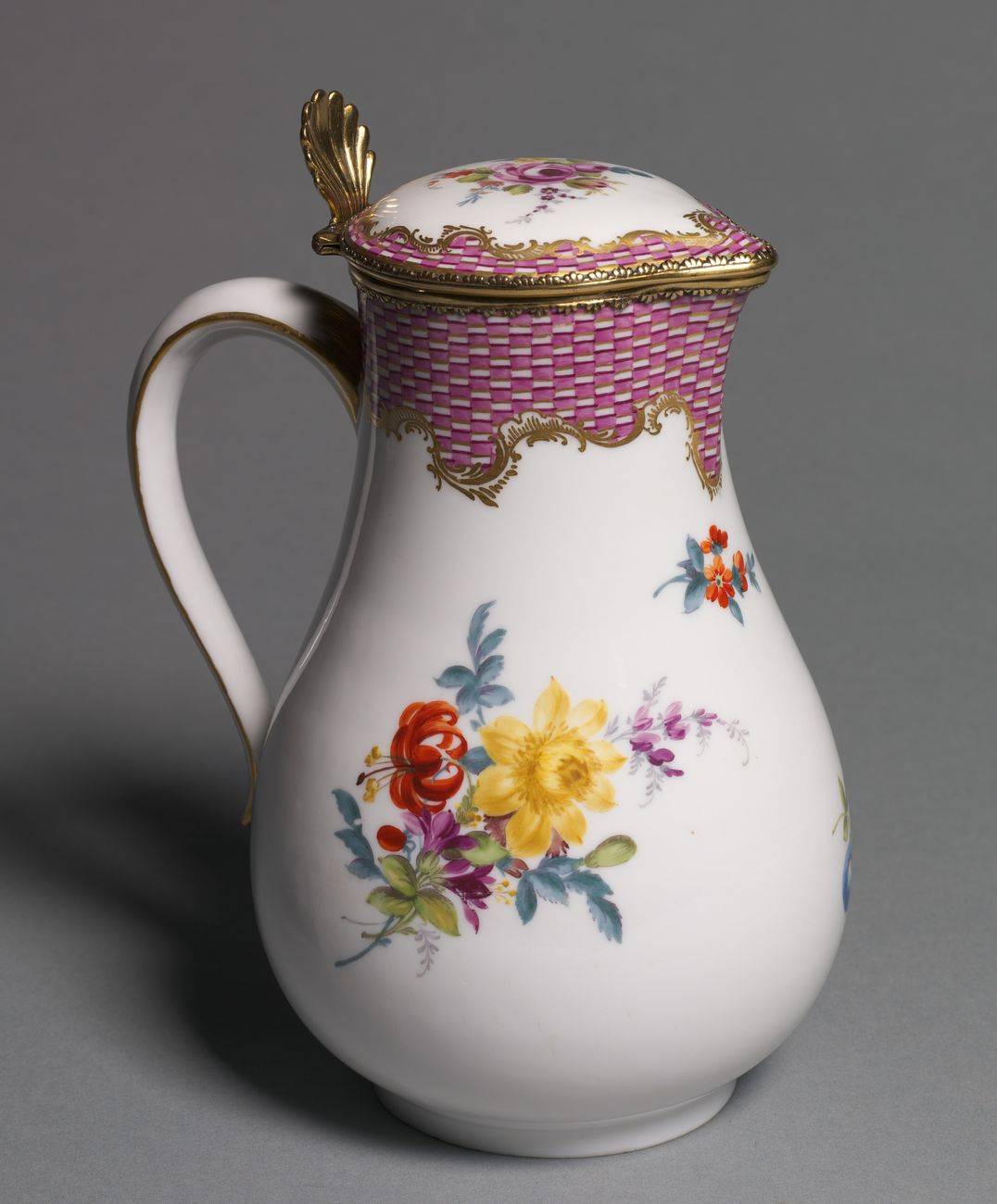
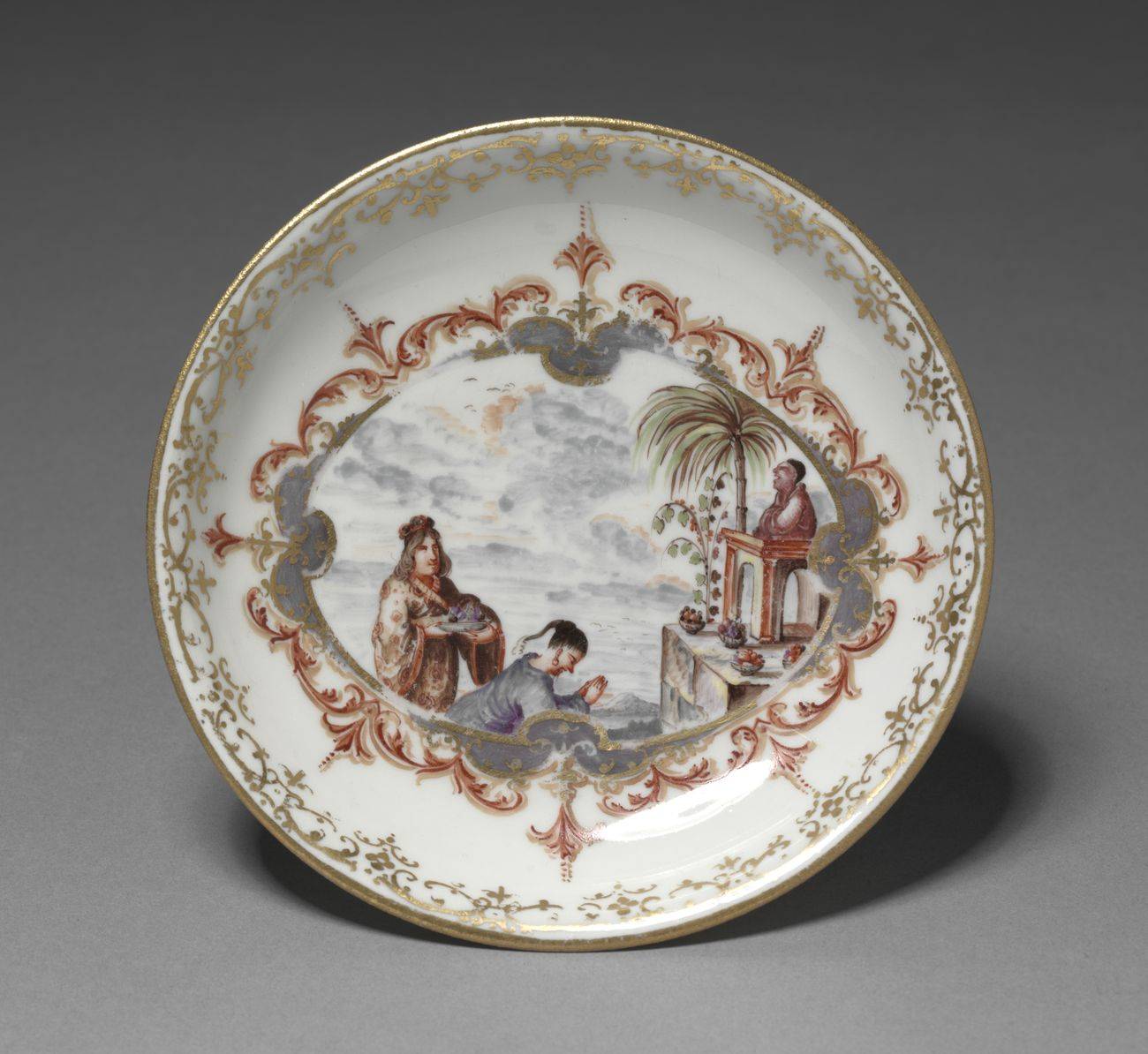
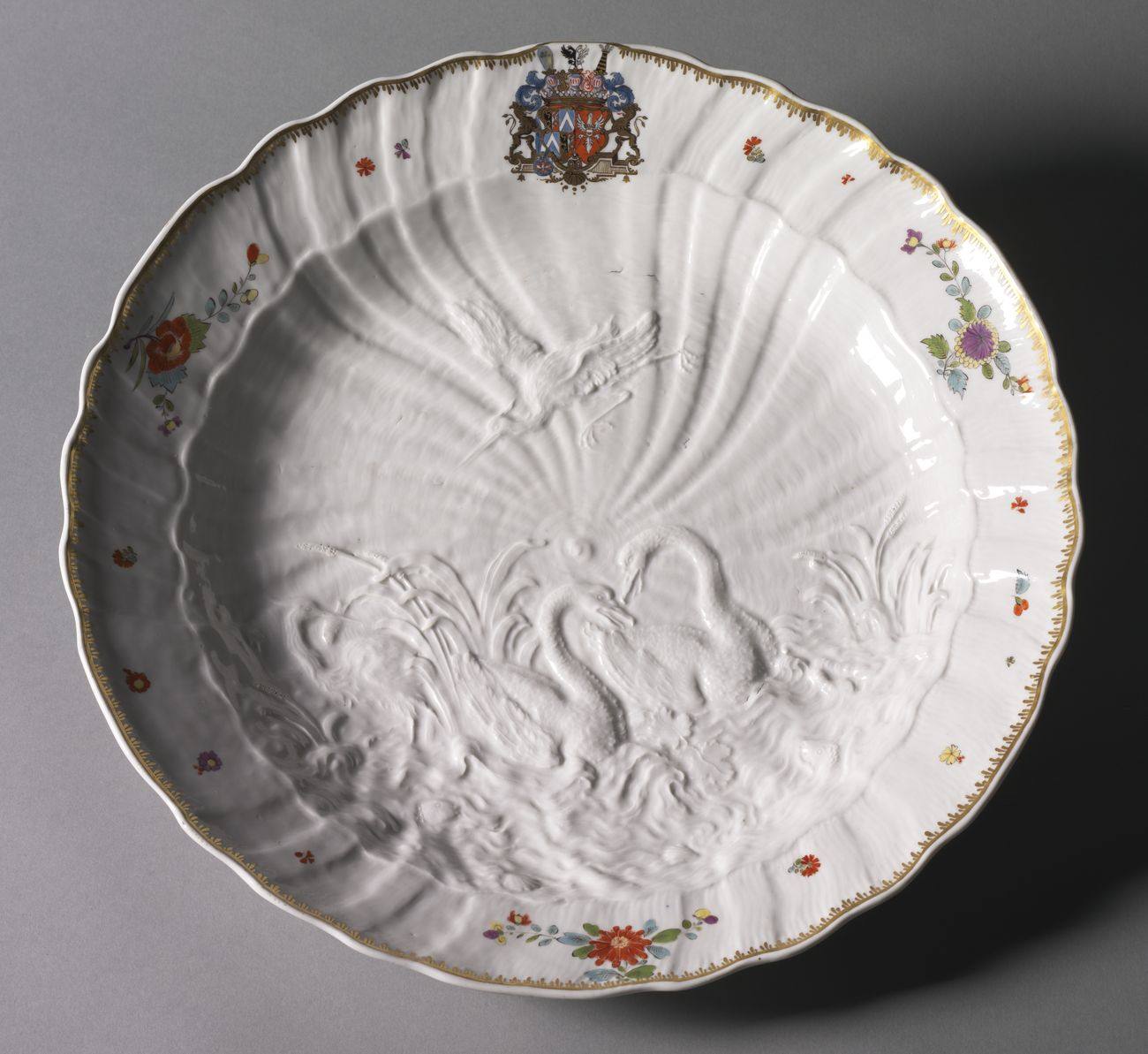
- Vase, 1749. Cleveland Museum of Art.
- Pilgrim Bottle, c. 1715. Cleveland Museum of Art.
What could not be confirmed
- No museum essay on the history of Meissen is quoted; the Met's essay could not be opened.
- The sources give different years for the start of the crossed swords and for the dot and star variants, so those dates are shown as ranges with each source named.
- No source used here gives a dated table of the nineteenth-century Meissen marks after 1814, beyond the trade mark office's 1875 registration and 1948 year sign.
- The earliest Böttger-period marks (the caduceus and incised signs) are in Burton and Hobson's table, but the scanned text is too scrambled to quote, so they are not described.
- The maker's page also mentions a Pfeiffer dot between the blades from 1924 to 1934, which is not yet recorded as a separate mark.
- There are no photographs of the marks.
Sources
- Handbook of Marks on Pottery and Porcelain (Burton and Hobson). Macmillan (scan of the archive.org copy listed as 1919; first edition 1909), 1919. Opened 22 November 2026.
- Marks and Monograms on European and Oriental Pottery and Porcelain (W. Chaffers, 1912 edition). Reeves and Turner, London, 1912. Opened 22 November 2026.
- The crossed swords (Traditional East brands). Deutsches Patent- und Markenamt (German Patent and Trade Mark Office). Opened 22 November 2026.
- 300 Years Swords Anniversary (Meissen history page). Staatliche Porzellan-Manufaktur Meissen GmbH. Opened 22 November 2026.
- Figure of a kneeling nymph, Meissen, ca. 1760-62 (museum no. O1300375). Victoria and Albert Museum. Opened 22 November 2026.
- Vase and cover, Meissen, ca. 1734 (museum no. O332838). Victoria and Albert Museum. Opened 22 November 2026.
- Teapot with cover, Meissen, 1722 (museum no. O333564). Victoria and Albert Museum. Opened 22 November 2026.
Photograph the piece and its mark
Velqo gives a first identification from photos of the piece and its mark.