
Dates of registration, grant and import
All four systems below were made by governments for their own purposes: protecting a design, granting a patent, or labelling imports. A date from any of them is a limit on when the piece could have been made, not the year it was made. Belleek puts it plainly about its own wares: a British registration mark gives the date of registration, not the date a piece was made.2
The British registration diamond, 1842 to 1883
The National Archives says diamond marks were used only on objects registered under the 1842 Ornamental Designs Act, and that they stop after 1883.1 The diamond carries a Roman numeral for the class of goods at the top, with letters and numbers at the corners. Class IV is ceramics (listed as earthenware), class III is glass and class I is metal.1
Which way round is it?
From 1842 to 1867 the letters are on the left point of the diamond and the numbers on the right. From 1868 to 1883 the letters are on the right and the numbers on the left.1 This matters because the year letters were reused with different meanings. A is 1845 in the first layout and 1871 in the second; R is 1861 and K is 1883.1 The Archives says the numbers give the day of registration and the letters give the year or month, but it does not say which corner holds which, so decode by trying both tables.1
The Archives also lists a few slips in the codes. R was used for 1 to 19 September 1857 (R normally means August), K for December 1860 (normally November), and from 1 to 6 March 1878 G stood for the month and W for the year.1 For wallpaper and textiles the diamond is often not visible, so its absence there tells you nothing.1
You will find diamonds alongside makers' marks. The V&A records a Minton date code and a diamond registration mark on a lettuce jug it dates to 1856.3 The registration mark decoder holds the year and month letters for both layouts.
Rd numbers, from 1884
From 1 January 1884 registered designs were numbered in one run starting at 1, and pieces were marked Rd No or Reg No with the number.1 The Archives gives the first series as numbers 1 to 518643, from 1 January 1884 to 8 January 1908, and the non-textile series as 518644 to 2012308, from 8 January 1908 to January 1991.1
Why the answer is a range
There is no official list of the first number issued each year. What the Archives does hold is its catalogue of bound volumes, each with a run of design numbers and the dates of the first and last entries.4,5 So a number can be placed in a volume and its covering dates, which is a span of days or weeks, never a single day. The Archives' own example is a 1908 tea set with design number 519057, in a volume covering 8 to 21 January 1908.1,5
The volumes also correct some popular charts. Number 18993, given in one collector table as the first of 1885, sits in a volume covering 12 to 29 December 1884.4 Textile designs had their own numbers from 1908, and the Archives warns that a number may appear in more than one table, so check that a number fits the style of the piece.1
Some numbers are not dates at all. Belleek says the REG No 0857 on its 1926 to 1946 mark is a registry number dating from 1884 that the company used only from 1926.2 The Rd number lookup returns the volume and its dates for numbers up to about 1950.
US patent numbers: the year of grant
The US Patent and Trademark Office says its present numbering began with a patent issued on 13 July 1836, and that an estimated 9,957 patents issued before that are outside the system.6 Its table gives the first utility patent number of each year. For example, 1876 began at 171641 and 1877 at 185813, so a number between them was granted in 1876. Design patents have their own series, starting at D1 in 1843.6
The USPTO page has since been removed, so the table here was read from an Internet Archive copy. It runs to 2019, and later years to 2023 come from the Official Gazette.6,7
A patent date is the earliest a piece could carry it, not the year of making. See the US patent number lookup.
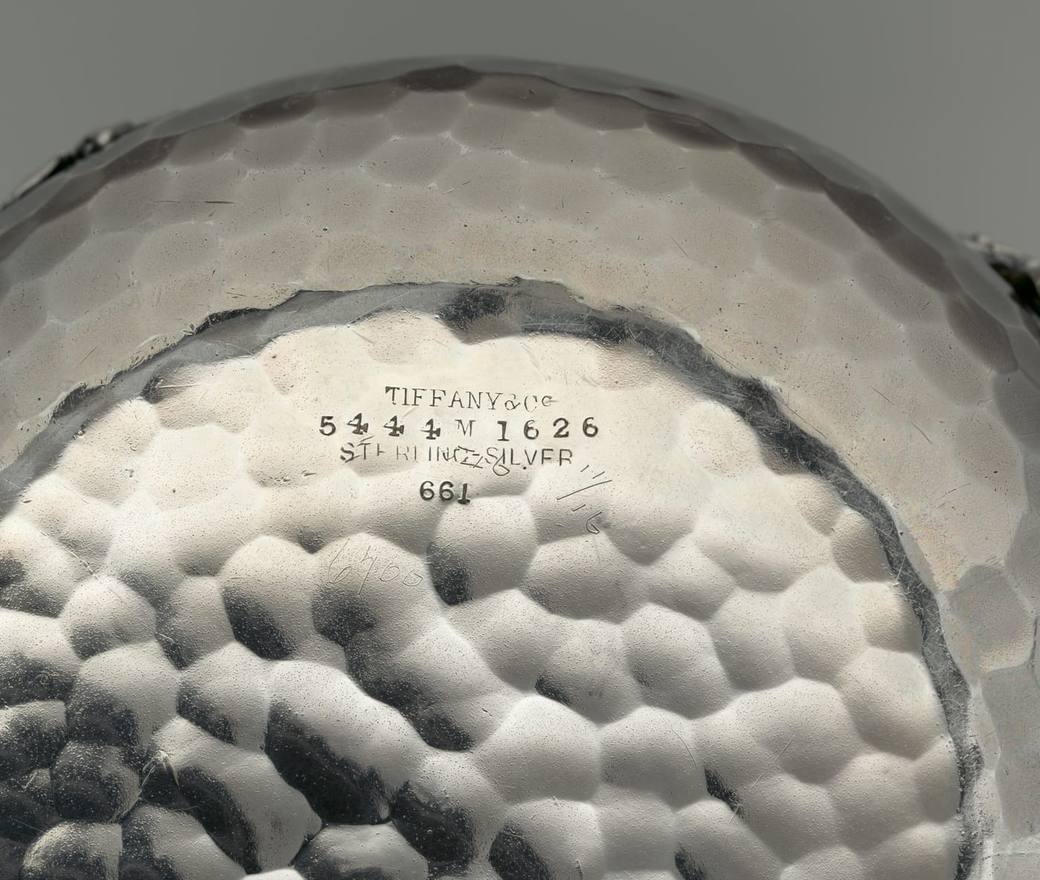
None of the sources opened for this site says what the letter M and the numbers on Tiffany silver mean, so no date should be read from them.15
Country names on imports to the United States
The McKinley Tariff Act says that on and after 1 March 1891, foreign goods of a kind usually marked had to be marked in legible English words to show their country of origin.8 The 1913 act added that the marking go in a conspicuous place and be as nearly indelible and permanent as the article allowed.9 The 1930 act, still the law today, asks for the English name of the country of origin.10
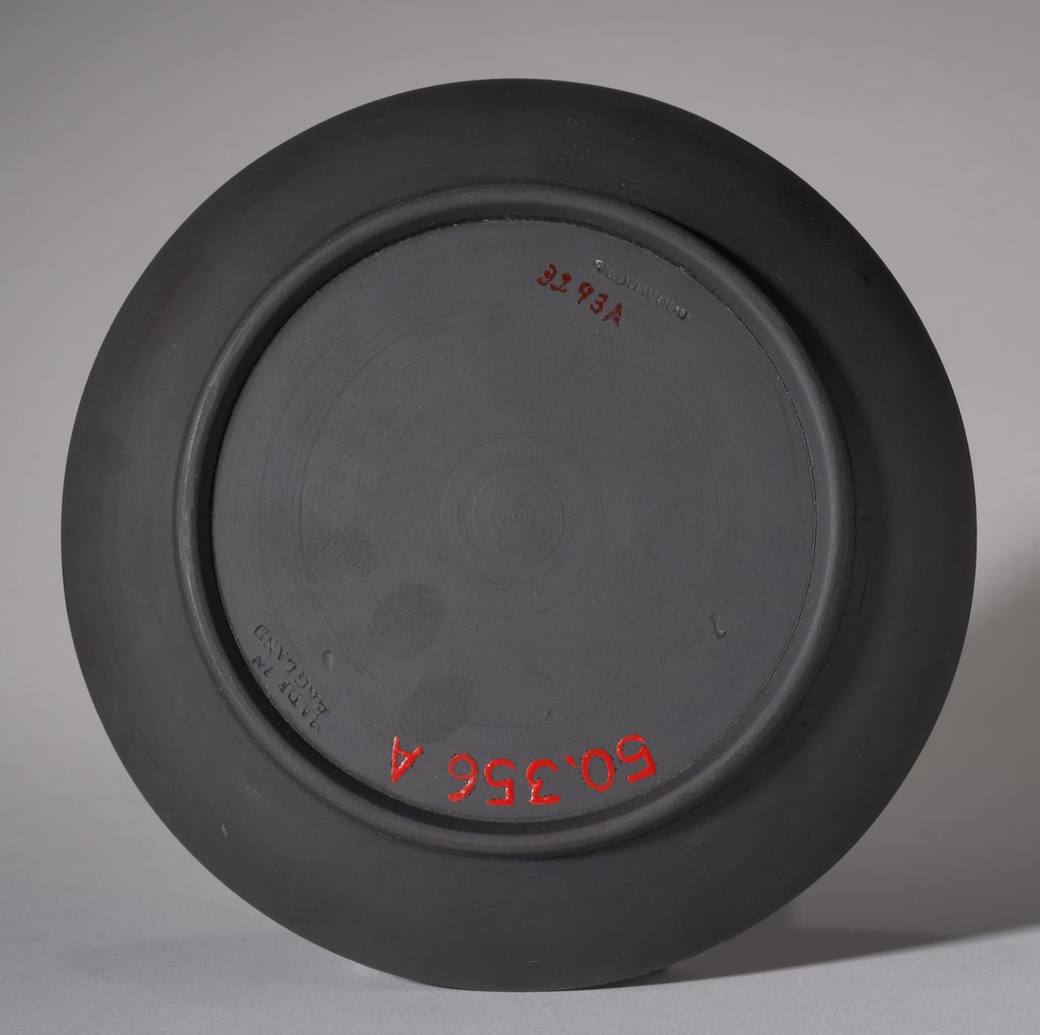
Belleek says it added the country to its mark in 1891 in response to the McKinley Tariff Act.2 Chaffers records ENGLAND added to the Wedgwood mark from 1891.14
What the law never said
None of these laws requires the words "Made in". Today's regulations ask for them only where a name such as United States or American also appears and could mislead.11 The research behind this site could not find any statute or ruling for several dates collectors often repeat: "Made in" becoming compulsory in 1914 or 1921, Nippon giving way to Japan in 1921, or set periods for US Zone Germany and West Germany. Treat those dates as collector lore, not law.
The laws only ever covered imports into the US, and they say nothing about when a piece was made. A piece without a country name can still be later, because some goods were exempt, some were marked only on a label or box, and labels come off.10
Made in Occupied Japan
This wording came from an order of the Allied occupation to the Japanese government, not from US Customs. SCAPIN-1535, dated 20 February 1947, required goods prepared for export after 15 days from receipt of the order, with their containers and outer packages, to be marked in English "Made in Occupied Japan".12 SCAPIN-2061 of 5 December 1949 cancelled it and allowed any of "Made in Occupied Japan", "Made in Japan" or "Japan", and let the mark be left off if the buyer asked and certified that the destination country did not require it.13 So it was compulsory only from early 1947 to December 1949. The sources opened here do not give an end date for its use after that. The country of origin tool checks a wording against these rules.
Sources
Every fact above is taken from these sources. The small numbers in the text point to them.
- How to look for records of... Intellectual property: registered designs 1839-1991
- Date Your Belleek: Official Marks and Certification
- Lettuce jug, Minton, 1856 (museum no. O151060)
- BT 50: Board of Trade: Patents, Designs and Trade Marks Office: Patents, Designs and Trade Marks Act 1883: Designs Representations (710 volume-level catalogue records read through the Discovery API)
- BT 52: Design Representations 1908-1991, sub-series 'Non-textiles Designs Representations' (3,180 volume-level records read through the Discovery API)
- Issue Years and Patent Numbers (Table of Issue Years and Patent Numbers, for Selected Document Types Issued Since 1836)
- Official Gazette Notices, Patent and Trademark Office Notices (table of contents and notice of maintenance fees payable) for issue dated January 13, 2026 (week 02)
- Tariff Act of 1890 (McKinley Tariff), ch. 1244, 26 Stat. 567, section 6 at p. 613
- Tariff Act of 1913 (Underwood), Pub. L. 63-16, ch. 16, 38 Stat. 114, section IV paragraph F at p. 194
- 19 U.S.C. 1304: Marking of imported articles and containers (with Prior Provisions note)
- 19 CFR 134.46 Marking when name of country or locality other than country of origin appears
- SCAPIN-1535: Marking of Export Articles (20 February 1947)
- SCAPIN-2061: Marking of Export Articles (5 December 1949)
- Marks and Monograms on European and Oriental Pottery and Porcelain (W. Chaffers, 1912 edition)
- Cleveland Museum of Art Open Access API, 1975.114.1 (Coffee Pot, c. 1879)
- Saucer, Wedgwood Factory (British), 1800s (accession 1950.356.b)
- Pitcher, Tiffany & Co., ca. 1880 (accession 2016.690)
Last checked: 22 November 2026. Compiled with the help of AI from the sources on this page and checked against them. Published by The Apptor. How this is made.