A row of marks, each with a job
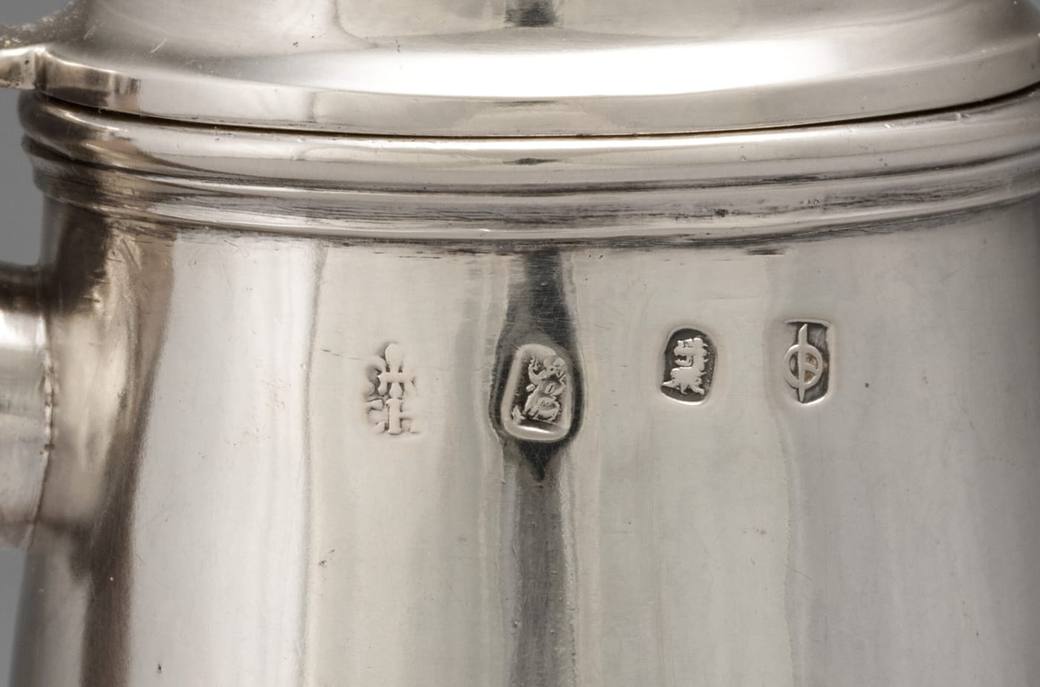
British silver is usually marked with several small punches struck side by side. Read them as a set rather than one at a time. The marks this guide covers are the standard mark, which gives the fineness, and the date letter, which gives the year of marking.
The standard mark: how much silver
The Hallmarking Act 1973 sets out the approved standards. For silver they are 800, 925, 958.4 and 999 parts per thousand, and the standard mark is struck as the figures, 958 rather than 958.4.1 The Act also allows a traditional picture beside the figures:
| Figures | Traditional mark in the Act | Name in the assay offices' notes |
|---|---|---|
| 925 | A lion passant (a lion rampant at the Edinburgh office) | Sterling silver |
| 958 | The figure of Britannia or a lion passant (lion rampant at Edinburgh) | Britannia silver |
| 999 | The figure of Britannia or a lion passant (lion rampant at Edinburgh) | No name given |
| 800 | No traditional mark | No name given |
The words sterling and Britannia are not in the Act itself; they are the labels the assay offices' guidance notes print beside the symbols.1,2 For gold the figures are 375, 585, 750, 916, 990 and 999, with a crown as the traditional mark; platinum uses an orb with a cross, and palladium the head of Pallas Athene.1
These are today's standards, in force since 1 January 1999. Older pieces may have been tested under earlier rules that this source does not cover.1 The London date-letter table does record one earlier change: Britannia standard marks were used from 1697 and the old standard was restored in 1720.5
A number is not always British
The international Hallmarking Convention lists silver standards of 999, 925, 830 and 800.3 German law of 1884 let silver carry a fineness mark only at 800 or more, and a notice of 1886 set the stamp as a crown and a crescent with the fineness.4 So 800 or 830 on a piece is worth reading alongside the other marks before assuming a British origin. The purity marks tool looks up any of these numbers.
The date letter: which year
Each assay office struck a letter that changed every year, working through an alphabet and then starting again in a new style of letter or a new shield. That is why one letter cannot give a year on its own.5 In London, a small Roman u appears in five different cycles, standing for 1755 to 1756, 1795 to 1796, 1835 to 1836, 1875 to 1876 and 1915 to 1916.5
How a London cycle works
- A London cycle normally ran to 20 letters, with J left out.5
- The letter changed on 29 or 30 May; before 1660 it changed on 19 May.5,6
- So a year written "1718 to 1719" runs from late May 1718 to late May 1719, and a piece marked in January to May carries the previous year's letter.5
- Example: in the cycle of Roman capitals that begins in 1716, C stands for 1718 to 1719.5
Sources differ even on the alphabet. Chaffers's text says London used A to U, always leaving out J, W, X, Y and Z, but his own tables show some cycles ending at V instead of U.5 The shield around the letter helps tell look-alike cycles apart: Chaffers says the London letter was first put in a shield in the cycle beginning 1558, and Jackson says the shield has been used since 1560 to 1561.5,6 Chaffers notes that the two small Roman cycles of 1736 and 1776 are told apart by the King's head duty mark, which London added from 1784 to 1785.5
Other offices changed on other days
Birmingham changed its letter in July, Sheffield on the first Monday in July, Edinburgh on the first Hall day in October and Glasgow on 1 July.5 Sheffield did not always follow the alphabet: its cycle beginning 1799 runs E, N, H, M and onward in a scattered order.5
What the tables cover, and what they do not
The date-letter tables here are read from two books of 1921 and 1922, so they stop around 1921.5,6
| Office | Years covered | Notes |
|---|---|---|
| London | 1478 to 1920–21 | 23 cycles; the last is partial |
| Birmingham | 1773 to 1921–22 | Six cycles |
| Sheffield | 1773 to 1921–22 | Letters of the first cycle (1773 to 1798) could not be read from the scan |
| Edinburgh | 1681 to 1921–22 | Letters of 1755 to 1780 are inferred from the year spacing |
| Glasgow | 1819 to 1896–97 | Three cycles |
Chester, Exeter, Newcastle, York and Dublin are not in the data, and no open official table was found for any office from 1922 to 1974.5,7 For those years the honest answer is that this site cannot give a letter.
Since 1975: one letter for the whole UK
The Sheffield Assay Office says the same date letter has been used by all four UK assay offices, changing on 1 January each year, since 1975, and that the letter became a voluntary mark from 1999.7 The 1998 regulations say the date letter is struck only if it is asked for, so many modern pieces have none.8 The assay offices' guidance notes print the letters for 2021 to 2030: w, x, y and z for 2021 to 2024, then capitals A to F for 2025 to 2030.2 Letters for 1975 to 2020 are not in the data. The silver date letters tool looks up the cycles above.
Plated words that are not silver marks
Some marks look official but describe plate, not solid silver:
- EPNS: the V&A gives it as electroplated nickel silver, a base alloy plated with silver.9
- Nickel silver or German silver: the 1911 Britannica calls it an alloy of copper, nickel and zinc.10
- Sheffield plate: the same encyclopaedia describes copper coated with silver, by a process abandoned by 1911.11
Weight and melt value
Silver is weighed in troy units. The US National Institute of Standards and Technology gives one troy ounce as 31.1034768 grams, or 20 pennyweights, or 480 grains.12,13 NIST also notes that prices actually offered for metal usually reflect deductions, so a melt figure is the metal value only.12 The melt value calculator works it out from the weight and the standard mark.
Sources
Every fact above is taken from these sources. The small numbers in the text point to them.
- Hallmarking Act 1973, Schedule 2 Part I (Approved Hallmarks), as substituted 1.1.1999
- Hallmarking Guidance Notes (November 2022), information from the Assay Offices of Great Britain
- Convention on the Control and Marking of Articles of Precious Metals (English text with Annexes)
- Gesetz ueber den Feingehalt der Gold- und Silberwaren (FeinGehG, dated 16.07.1884) and Bekanntmachung of 7.1.1886 (FeinGehStempG)
- Hall marks on gold & silver plate, illustrated with revised tables of annual date letters employed in the Assay Offices of England, Scotland and Ireland (Chaffers; revised by C. A. Markham), 1922 edition
- English Goldsmiths and Their Marks (C. J. Jackson), 2nd edition 1921
- UK Hallmarks - Sheffield Assay Office
- The Hallmarking (Hallmarking Act Amendment) Regulations 1998 (SI 1998/2978)
- Victoria Plate (fork, J. Derby and Sons Ltd, Sheffield, about 1890), V&A Explore the Collections
- Encyclopaedia Britannica, 11th edition (1911), 'German Silver'
- Encyclopaedia Britannica, 11th edition (1911), 'Sheffield Plate' (Malcolm Bell)
- Conversion Factors for Precious Metal Sales (NIST OWM, 6/17/10, rev. 3/15)
- NIST Handbook 44 (2026), Appendix C. General Tables of Units of Measurement
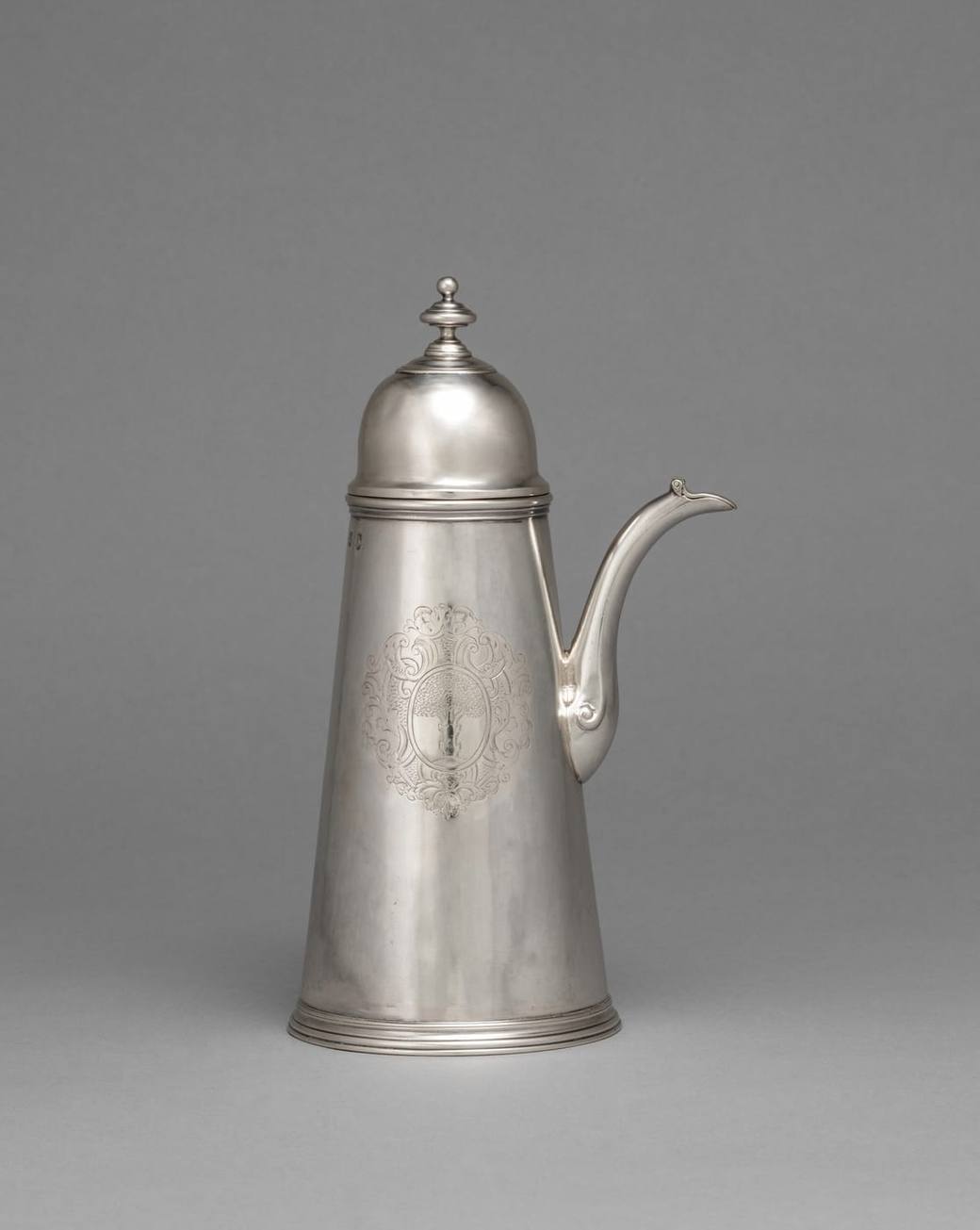
- Coffee Pot, John Chartier (British), 1702 (accession 1987.163)
Last checked: 22 November 2026. Compiled with the help of AI from the sources on this page and checked against them. Published by The Apptor. How this is made.